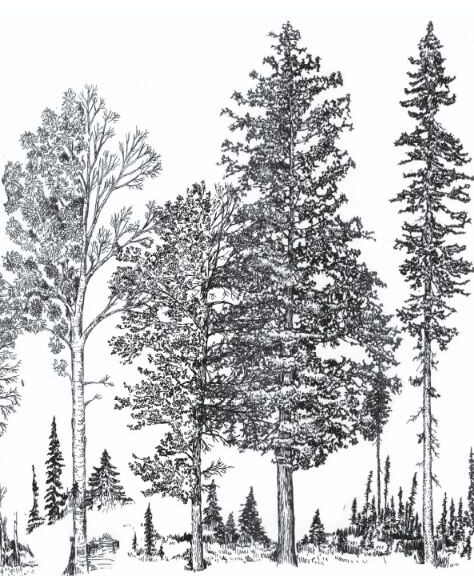
Trees of Alaska
I’m nearing the end of the research for my trip – and just as well as I leave in just a few days! So, it was great that another trip buddy ventured up some information on the trees we might encounter in Alaska. (Thanks, John!)
This is not an area which would have normally beckoned me to write about. But as I started reading, I became intrigued about some of the snippets of information I was coming across.
I still haven’t been fully converted to tree-hugging, but I am interested. So, rather than simply listing the varieties of trees found in Alaska, I decided to approach this post from a different angle….
… I wanted to know what was special about Alaskan trees.
To start with, and no surprises here, Alaskan trees are particularly well suited to their extremely cold environment. As I describe each species (or groups of species) I will explain.
Spruce Trees
There are several different types of spruce trees found in Alaska; Sitka Spruce, White Spruce and Black Spruce. Each of the different types can be found thriving in different locations.
An important fact here is that the Sitka Spruce is the official tree of Alaska.
And what is interesting about spruce trees is their thermal regulation properties. Because their dark needles absorb low-angle solar radiations, and their snow canopies act as insulation, spruce forests create a warmer micro climate for wildlife in winter.
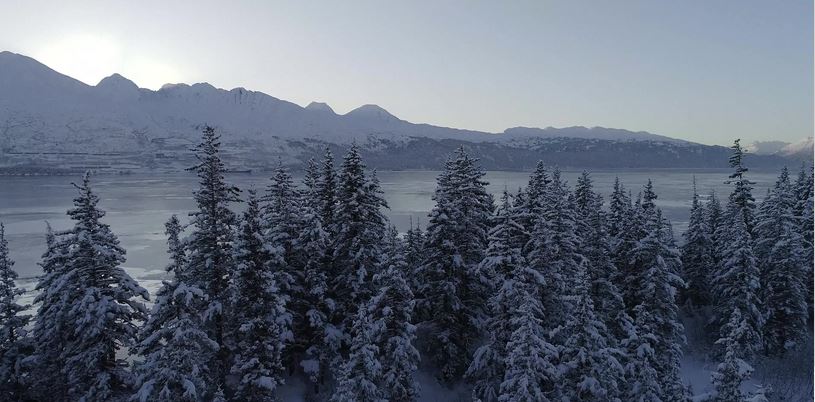
Spruce trees are also known as the tallest trees in Alaska, sometimes growing to 200 feet.
Plus I discovered that the Sitka Spruce wood is prized for its strength-to-weight ratio, which makes it sought after for musical instruments and aircraft parts.
Hemlock trees
The most common hemlock trees in Alaska are the Western Hemlock and the Mountain Hemlock.
Just to confuse things, one of the most common Alaska trees, the Western Hemlock, is often referred to as the Alaskan Spruce. While both belong to the same pine tree family, the Western Hemlock is not a spruce tree. It was probably given this nickname because it is found in the same forests as the Sitka Spruce.
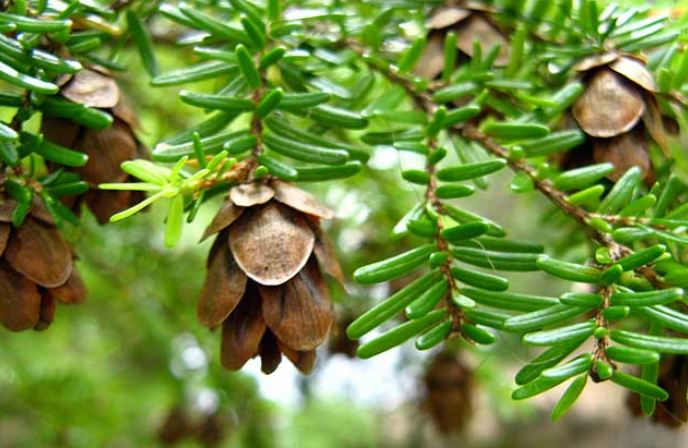
Hemlock trees also grow to great heights; generally, not as tall as spruce trees, but with heights of sometimes greater than 150 feet, they are nevertheless very tall!
The name ‘hemlock’ refers to the scent of the crushed foliage, which is similar to the smell of the poison herb of the same name. Importantly, the foliage from the tree is not poisonous and is sometimes used to make tea (although it could be harmful for pets)
Cedars
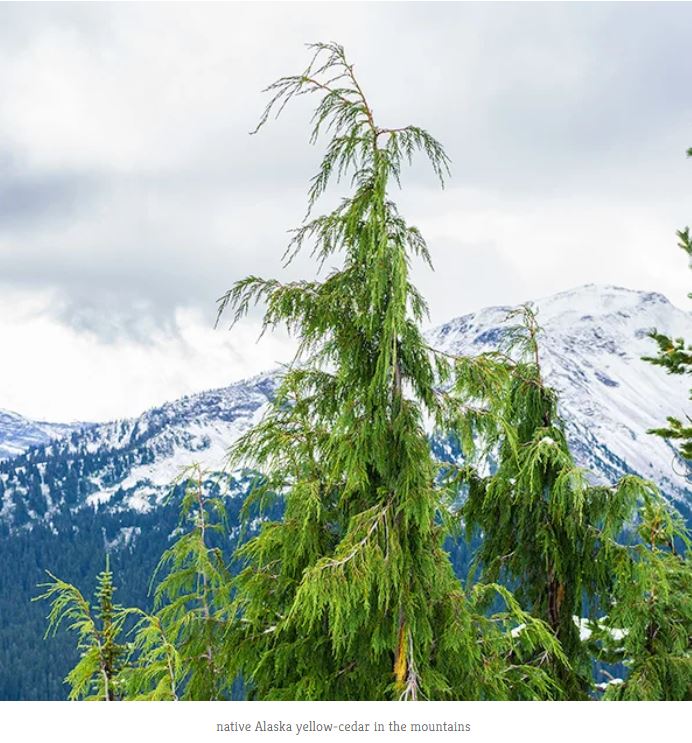
The Alaskan Yellow Cedar and the Western Red Cedar are native to Alaska.
Interestingly the world’s highest concentration of ancient trees is in the Tongass National Forest in Alaska and these ancient trees are Alaskan Yellow Cedars. Some specimens are known to be over 1,800 years old. (Both Western Hemlocks and Sitka Spruces also reach great ages, with Sitka Spruces commonly aged at between 300 and 700 years old)
Birches, Poplars and Aspens
In Alaska you can find Paper Birch, Quaking Aspen and Balsam Poplar trees.
I’ve grouped these trees together because of their ability to rapidly regenerate after fires. In this respect they are similar to the Australian eucalypts, and all are dominant, resilient and fast-growing in their respective harsh habitats.
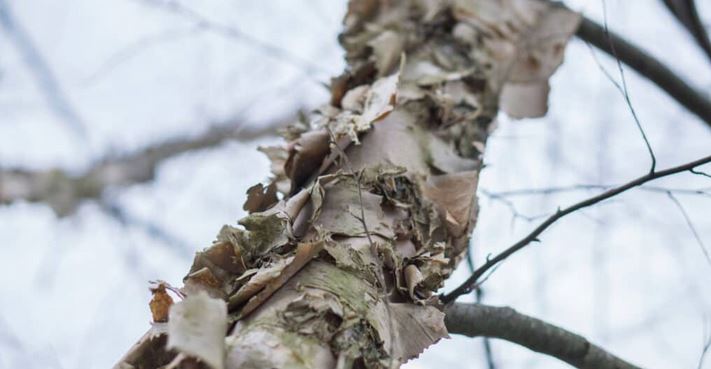
Also, there is such a thing as a ‘clonal network’. In Alaska, aspen trees and poplar trees form clones by spreading their roots underground and then connecting up to generate new single, and genetically identical shoots. These interconnected root networks allow entire groves to function as a single massive organism where individual trees share resources. Some of these underground root systems are ancient – in Utah, Pando is a clonal quaking aspen colony, which has a root system believed to be between 16,000 and 80,000 years old!
Willow
The Feltleaf Willow and Scouler’s Willow are two different types of willows found in Alaska.
In fact, the Feltleaf Willow (also known as the Alaska Willow) is considered the most plentiful tree in Alaska, being the most abundant and widespread.
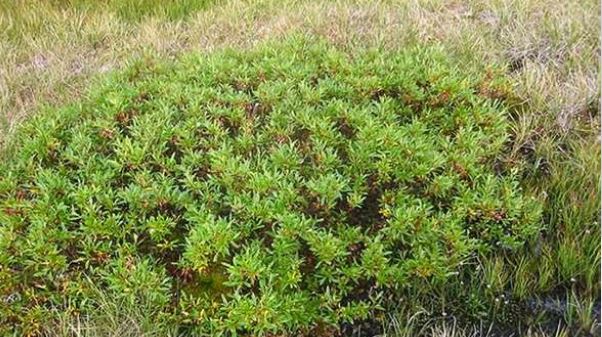
Ned Rozell’s opening words in his article on the UAF website describes the significance of this tree most delightfully:
“Imagine being a moose in late May: You have just survived 200 days of cold and darkness by munching the equivalent of a large garbage bag full of frozen twigs each day.
Now, billions of salad greens are unfolding from those same woody plants, providing a scent and texture savored for an instant before one sweep of the moose’s head strips a wispy branch. All over Alaska, moose are sucking in new leaves like whales inhaling plankton.”
I love the imagery of this!
Tamarack
Tamarack trees are conifers. However, unlike most other conifers which stay green all year, the Tamarack is deciduous. Its soft needles turn yellow in autumn and fall off.
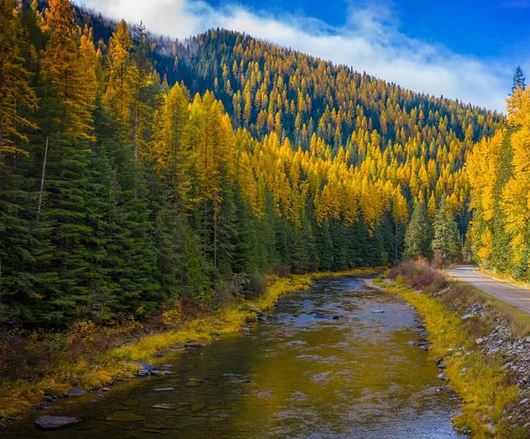
It’s all about the leaves…
Broadleaf v. Conifer
As the name implies, broadleaf trees have flat, broad leaves. They also have flowers, even though these are green and don’t look like a typical flower petal. Broadleaf trees in Alaska are deciduous (see below). Examples of broadleaf trees are Willow, Birch, Aspen and Balsam Poplar.
Conifers have leaves which look like needles or scales. (Like a Christmas tree). Conifers are evergreens; they keep their needles all year round. The Tamarack tree described above is the exception, as it loses its needles in Autumn.
Deciduous v. Evergreen
Simply stated, deciduous trees lose their leaves before winter, while evergreens (as the name suggests) keep their foliage all year round.
Deciduous trees are like bears, which go into hibernation when the days get shorter. They send vital nutrients to their roots and drop their leaves. Leaves are where trees keep the bulk of their water and without their leaves the trees stop producing energy through photosynthesis and effectively ‘go to sleep’ (biologists call it “dormancy) for the winter.
Evergreen trees have their own survival tactics. To avoid cell damage, they carry out a form of “intentional dehydration” by emptying the water from their cells and storing it in the spaces between their cells. This reduces the damage caused by freezing. Evergreen trees, such as the mighty Spruce, also produce their own anti-freeze, which also gives them their particularly piney smell.
To conclude:
There is a plethora of information available on the internet about Alaskan trees – about trees everywhere. The hardest part of writing this post was not trying to find the information, but trying to simplify. There are many accomplished and learned scientists who have become experts in this area, and have shared their knowledge.
What I didn’t realise, though, is that there are some forests in the world which are so remote that researchers just can’t easily get to them to study.
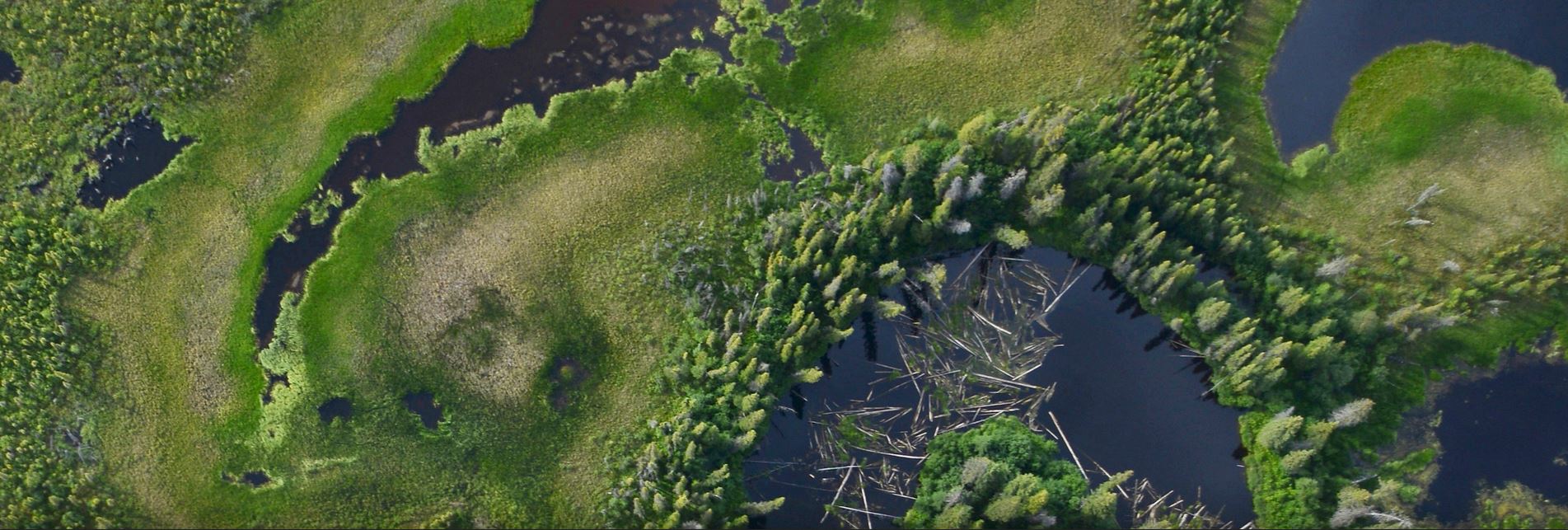
According to NASA scientist, Doug Morton, there is an area of around 450,000 square kms of forest in remote Alaska which is so difficult to reach that their forest inventory and analysis programme just doesn’t include it.
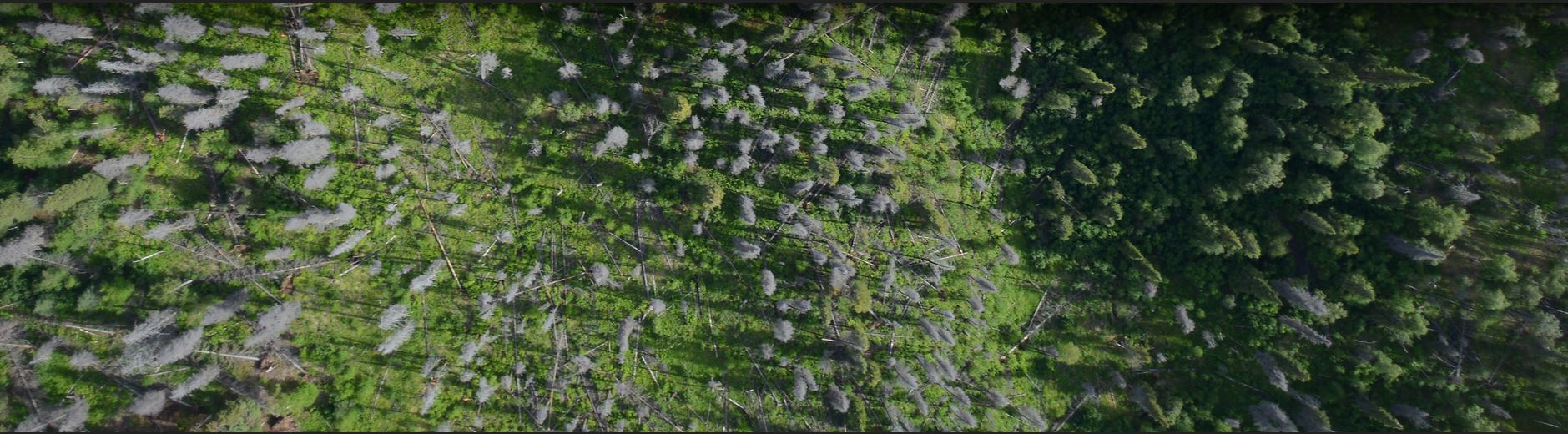
Aerial technology is changing that, though. So, I thought that I would finish with two of their photos…
…just to remind us of how vast and beautiful our precious forests are.
Sources:
-
US Department of Agriculture. Common Trees of Alaska
-
A-Z Animals. “14 Most Iconic Trees Native to Alaska.”
-
Alaska.org. “Alaska trees”
-
Alaska Dept of Fishing and Game. Tree basics
-
University of Alaska Fairbanks. “Feltleaf willows: Alaska’s most abundant tree”