City Impressions: Belfast
I took the train from Dublin to Belfast, and as soon as I walked out of the station, I noticed the difference between the cities. The impact of years of unrest and turmoil was obvious. Perhaps it was an ever-present tension? Or perhaps I was just imagining it?
Don’t get me wrong…I always felt safe, and never had the impression that I was holidaying in a place I shouldn’t be. It’s just that you get a sense of the pain that a city and its people have been through, particularly when the evidence is still visible.
It will be difficult to summarise the history of Northern Ireland, but I’ll give it a go. I need to insert a disclaimer here, for any errors in and the many omissions from, these notes. I have written this to provide context around my visit and to set the scene. And I still have ringing in my ears a warning given by one of the tour guides, when he advised: Don’t get into Irish history it will pickle your brains!
But I’m prepared to ignore the advice. So, let’s begin with my attempt at a history lesson……
Ever since the Normans invaded Ireland in the 12th century (just after they had conquered England) there have been struggles between the Anglo-Norman/English leaders and the native Gaelic Irish people, who became increasingly marginalised and downright discriminated against.
A notable episode of this was when Cromwell invaded Ireland in the late 17th century. Cromwell’s fanatical stance on religion resulted in a period of ruthless subjugation of the Catholic population, carrying out executions and confiscating properties.
Meanwhile, fast forward a hundred years or so.
In 1800 the Act of Union resulted in the United Kingdom of Great Britain and Ireland and abolished the Irish government with Ireland now being ruled by the British parliament. It was during this time that Daniel O’Connell emerged as a political figure focussed on achieving Irish emancipation and on obtaining a seat in the British Parliament. He became known as “The Liberator”. (See Dublin post and the photo of the statue of Daniel O’Connell)
The central issue throughout the 1800s and early 1900s was ownership of land. The English rule over Ireland resulted in the majority of land being held by English families, who were often not even resident in Ireland but managed their properties from England. Meanwhile, in the late 1800s (after the Great Hunger of the middle of the century) the people began to revive their Gaelic traditions; for example language, music, sports.
Now comes the period of intensified unrest.
The Easter rising occurred in 1916 in Dublin which was an attempt to overthrow British Rule and establish an independent Irish Republic. It was violently and brutally suppressed by the British.
This marked the start of the Irish War of Independence and the growing support for the republican party of Sinn Fein together with the formation of the Irish Republican Army (IRA). On the English side the “Black and Tans” were deployed to Ireland to “police” the situation.
In 1920 amid the turmoil in Ireland the Government Act of Ireland introduced home rule by creating a divided country of Northern Ireland and Southern Ireland (the Partition). Northern Ireland opted to stay within the UK. Southern Ireland became the Irish Free State. (A dominion with the British Empire, like Canada). Conflict continued, however, with the start of a civil war between the new provisional government and the Anti-Treaty IRA who wanted a completely independent Ireland.
Where does the Catholic v Protestant issue come into it?
So, after the Partition, Northern Ireland remained within the UK. While it was intended that this would neatly result in a protestant majority area, the existence of a resentful staunch Catholic minority stranded in Northern Ireland was not accounted for. In 1926 around 34% of Northern Ireland was Catholic (source. Sandra Knispel in Rochester.edu) And it was governed by a Protestant unionist party which introduced significant discrimination against Catholics.
Similarly, in the Irish Republic the government was committed to cultural nationalism, as well as a strong influence from the Catholic Church.
These divides, when coupled with the world-wide civil rights phenomenon of the 1960s, led to the period of violence in Ireland known as “The Troubles”. British troops were sent to Northern Ireland to quell the Republican (mainly IRA) uprisings. Having said this, violence was carried out by both IRA and loyalist factions. And bombings also occurred in England.
As I was driven around the city on the “Troubles Tour”, there was evidence of the past violence and of the underlying discontent.
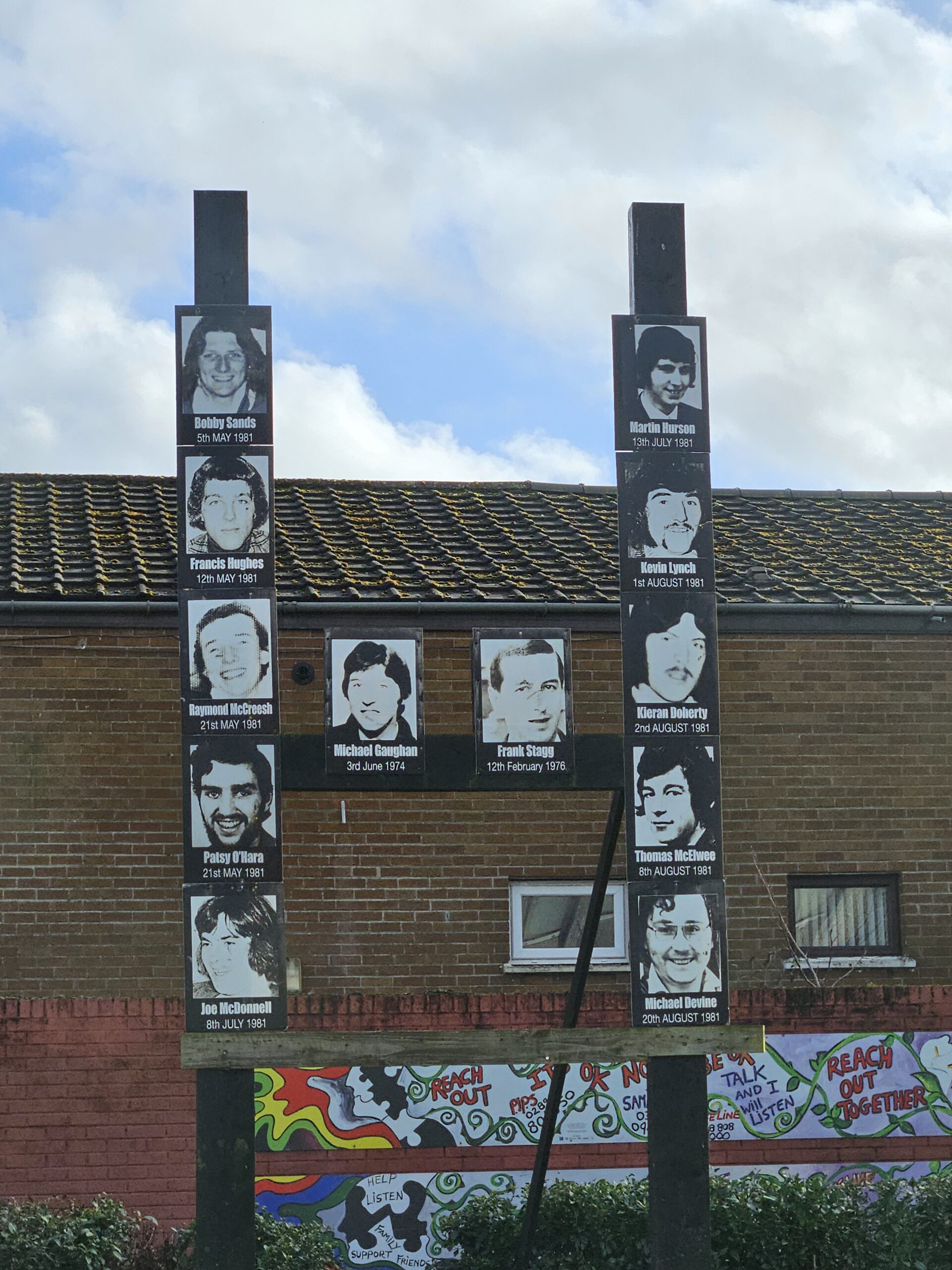
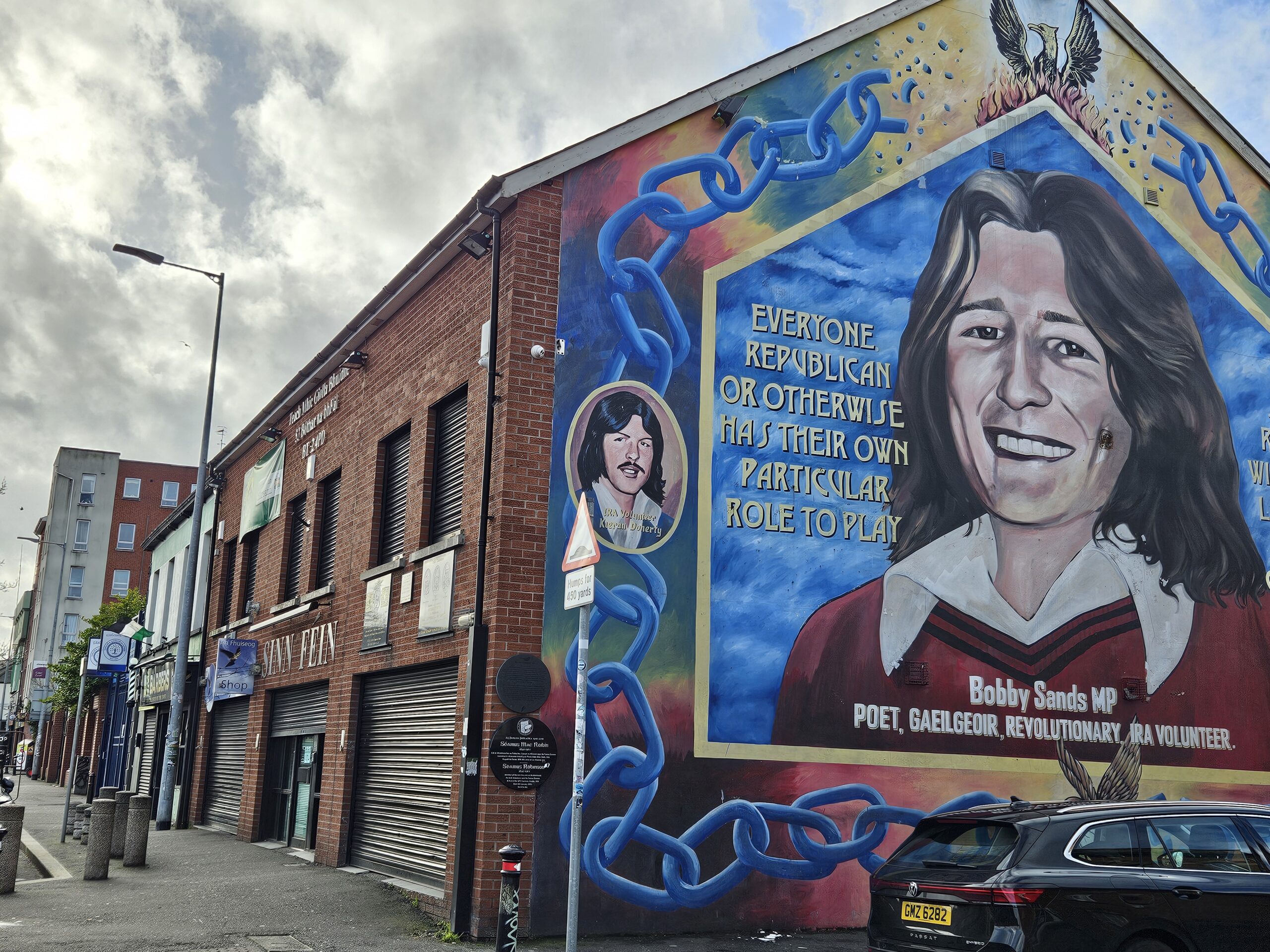
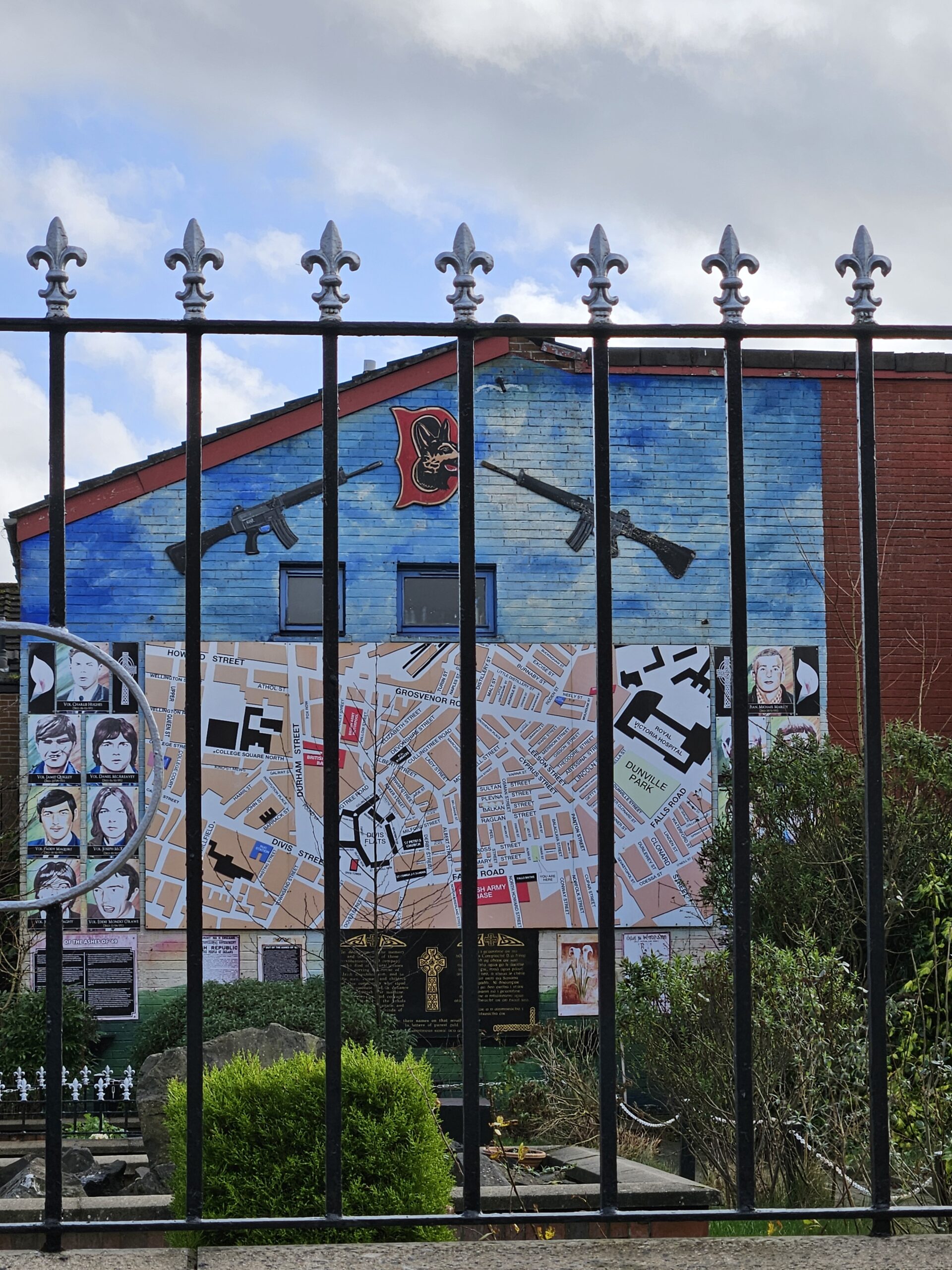
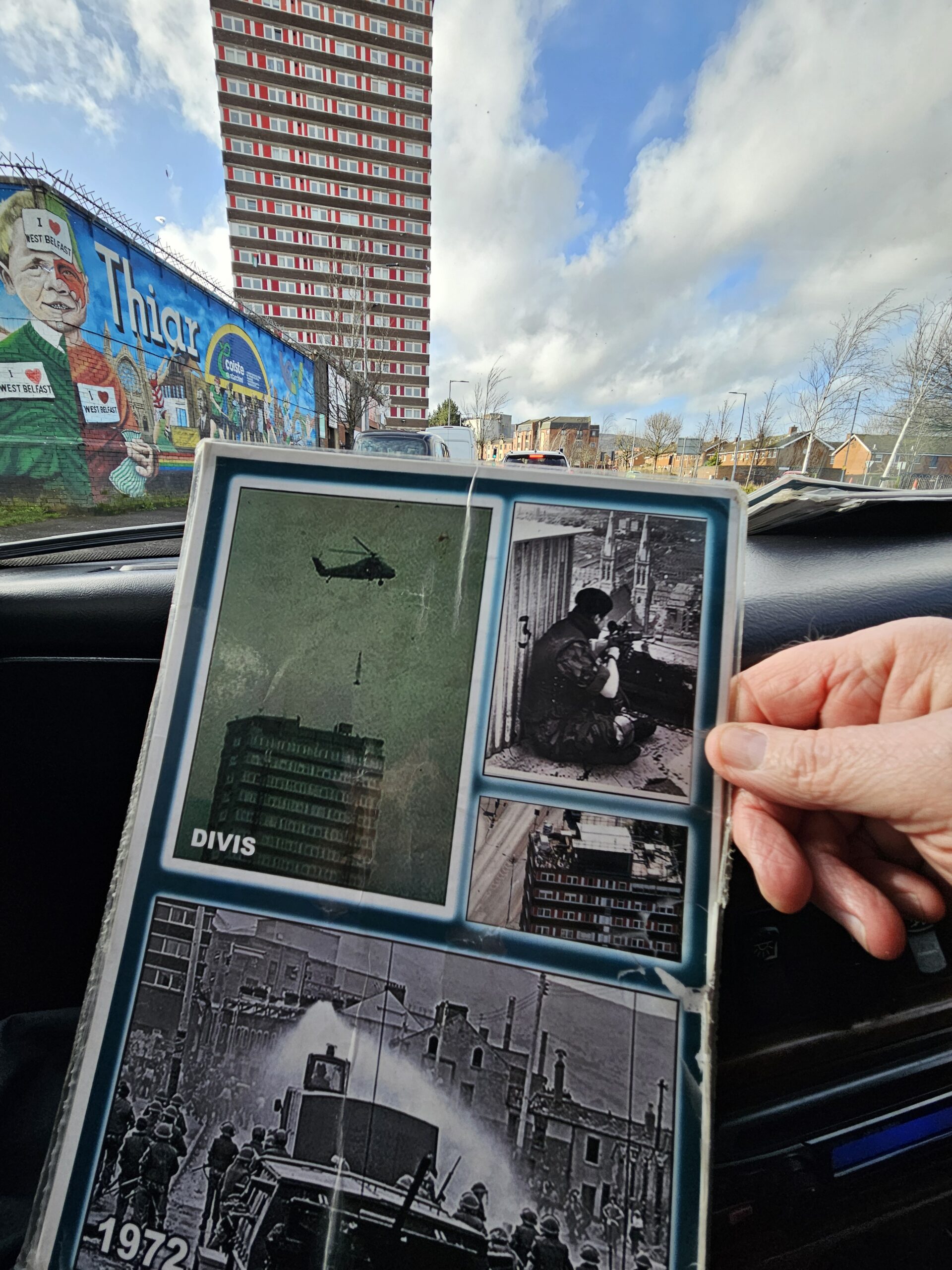
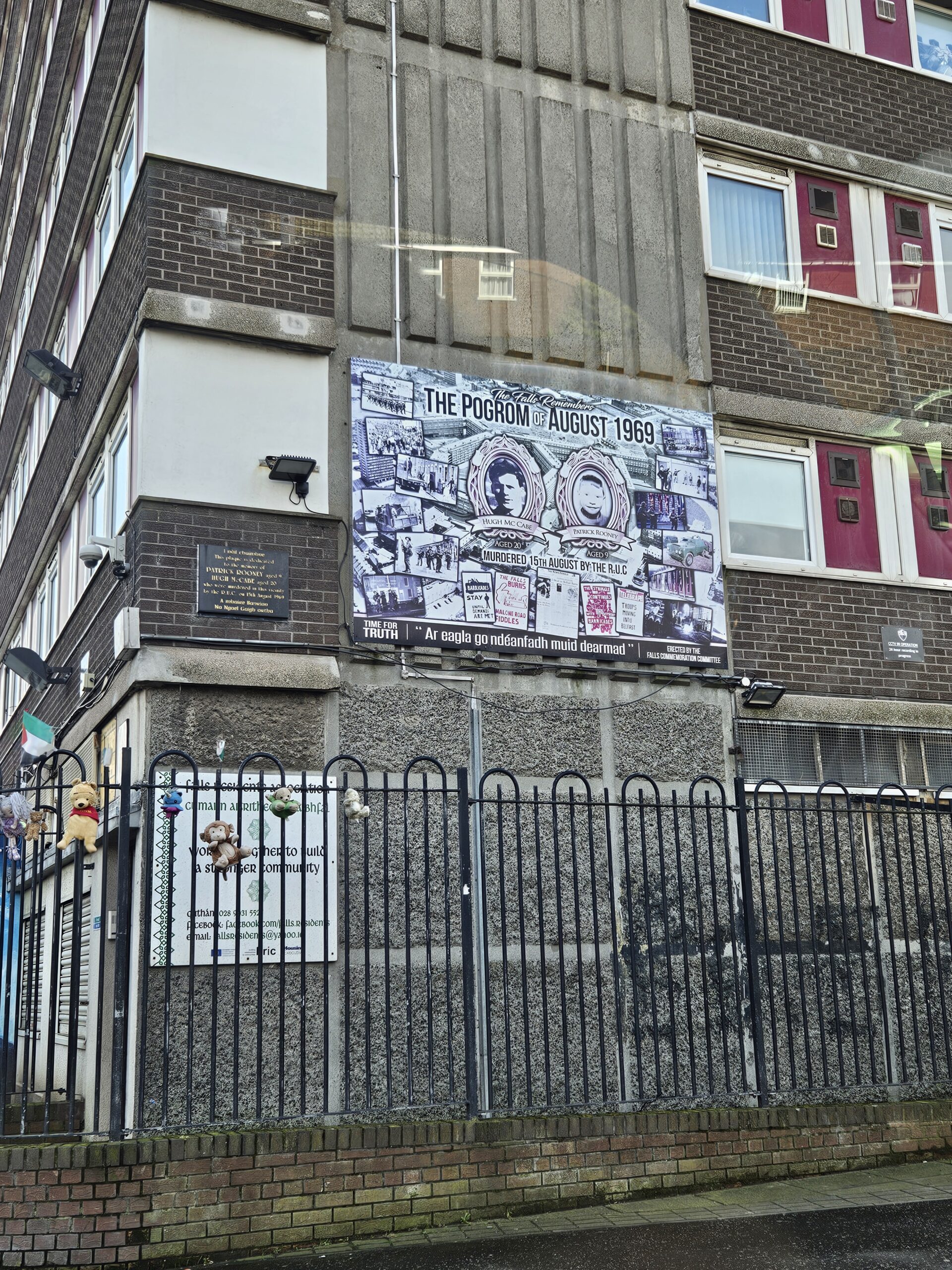
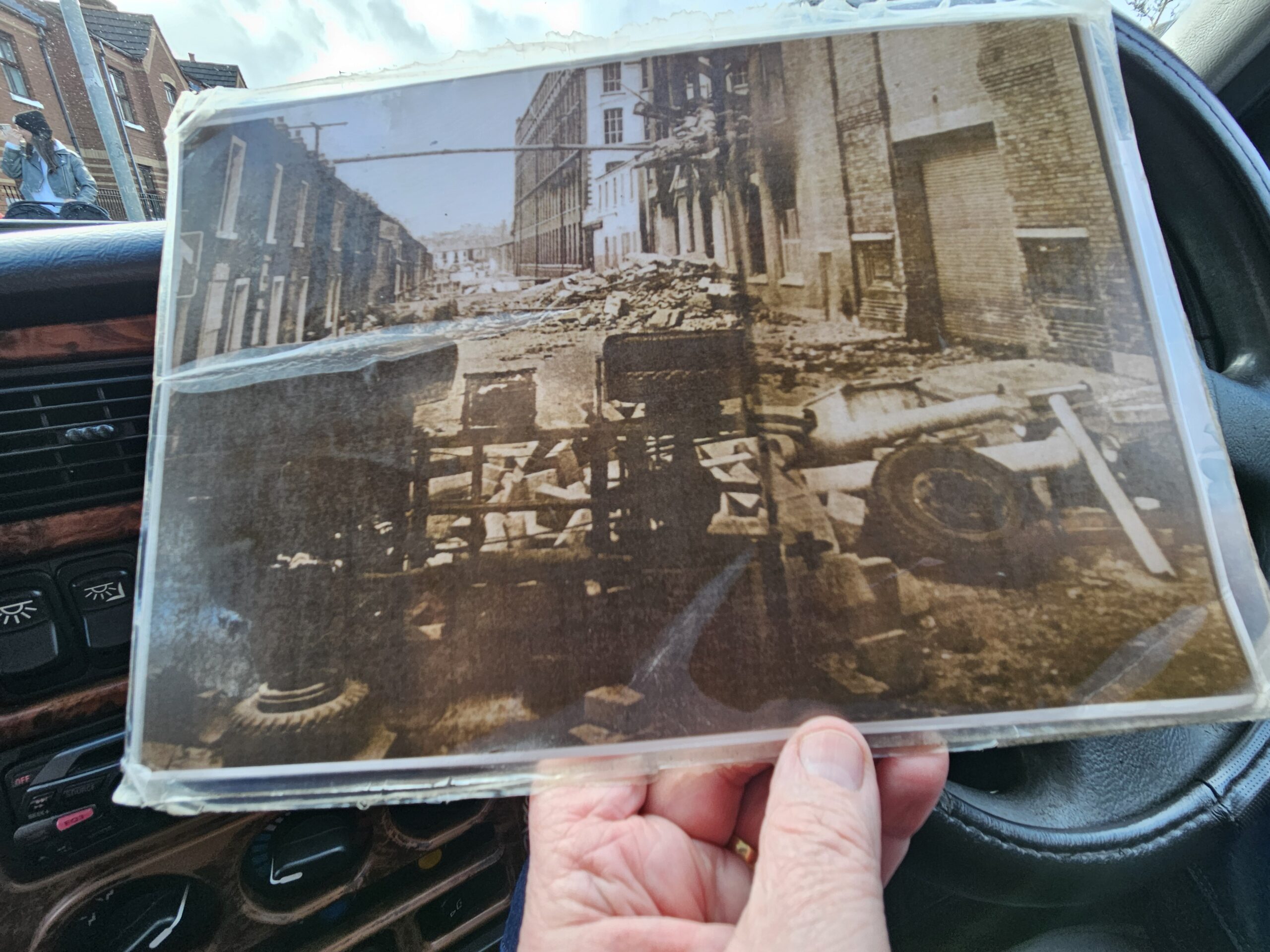
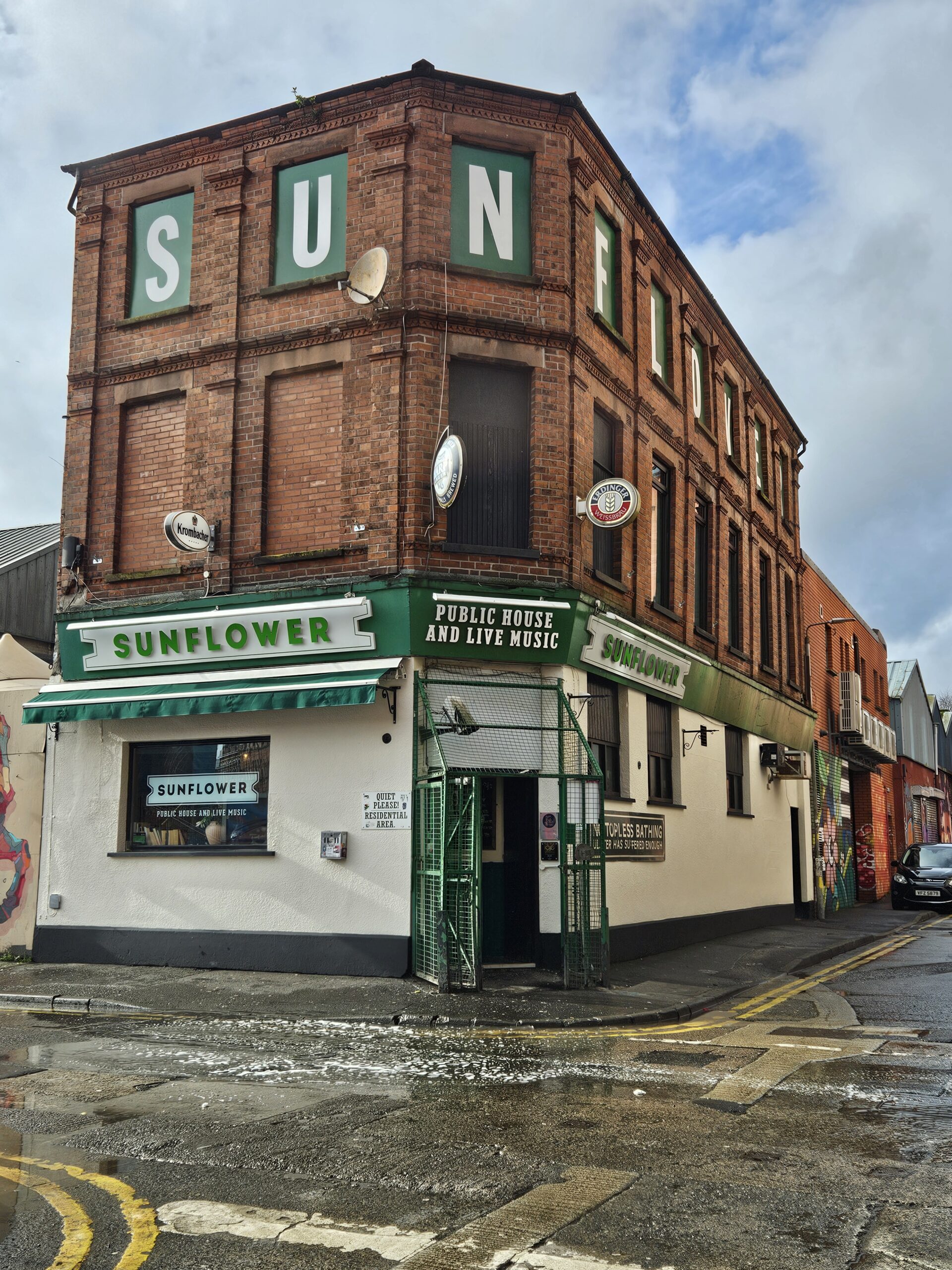
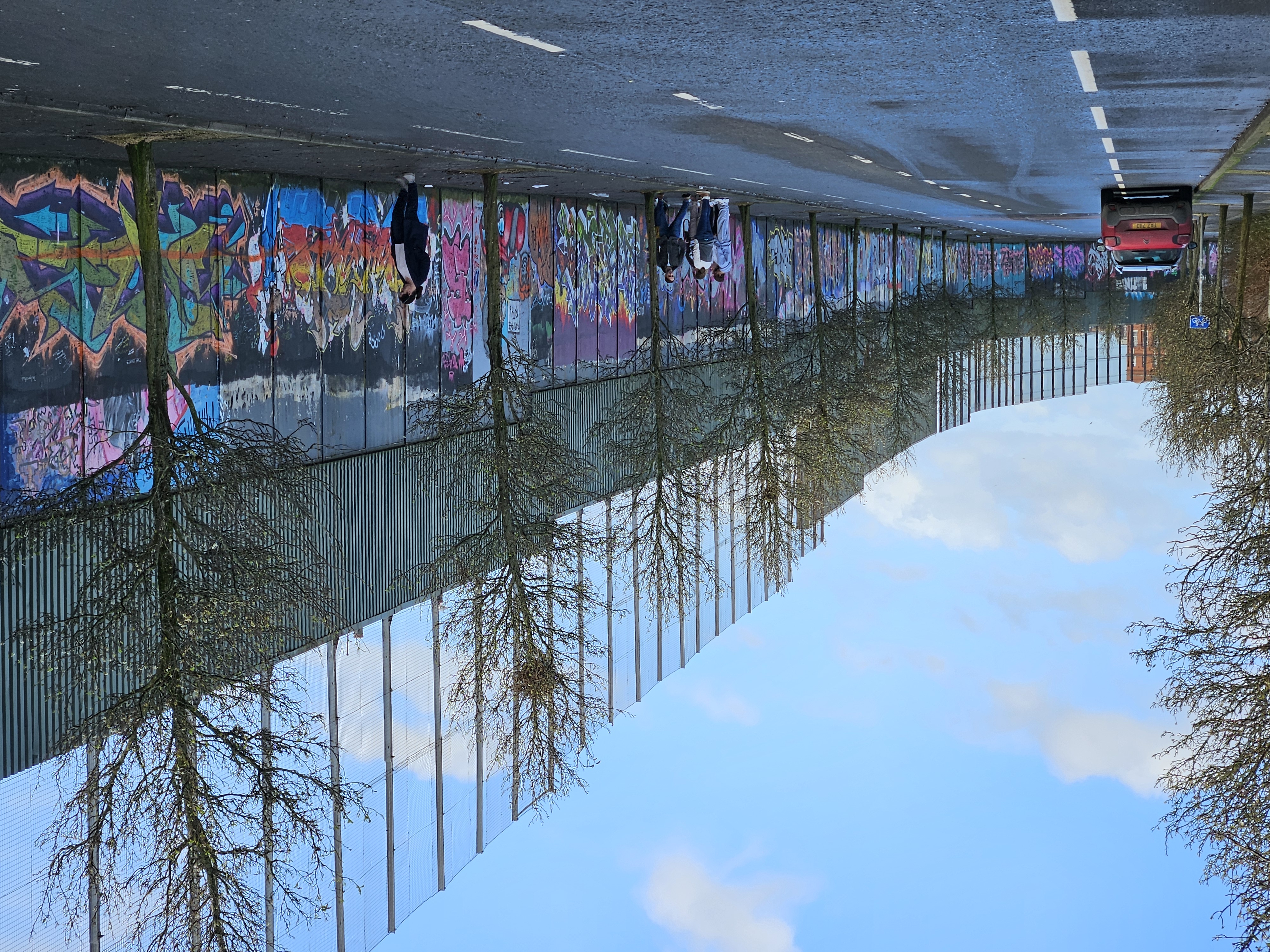
While there is a general (hopeful?) sentiment that Ireland may be reunited one day, I was surprised that evidence of the divide still exists. Unbelievable as it sounds, there are areas of Belfast which are still ‘quarantined’ at night. Sections of the city are walled off, and the gates closed at night.
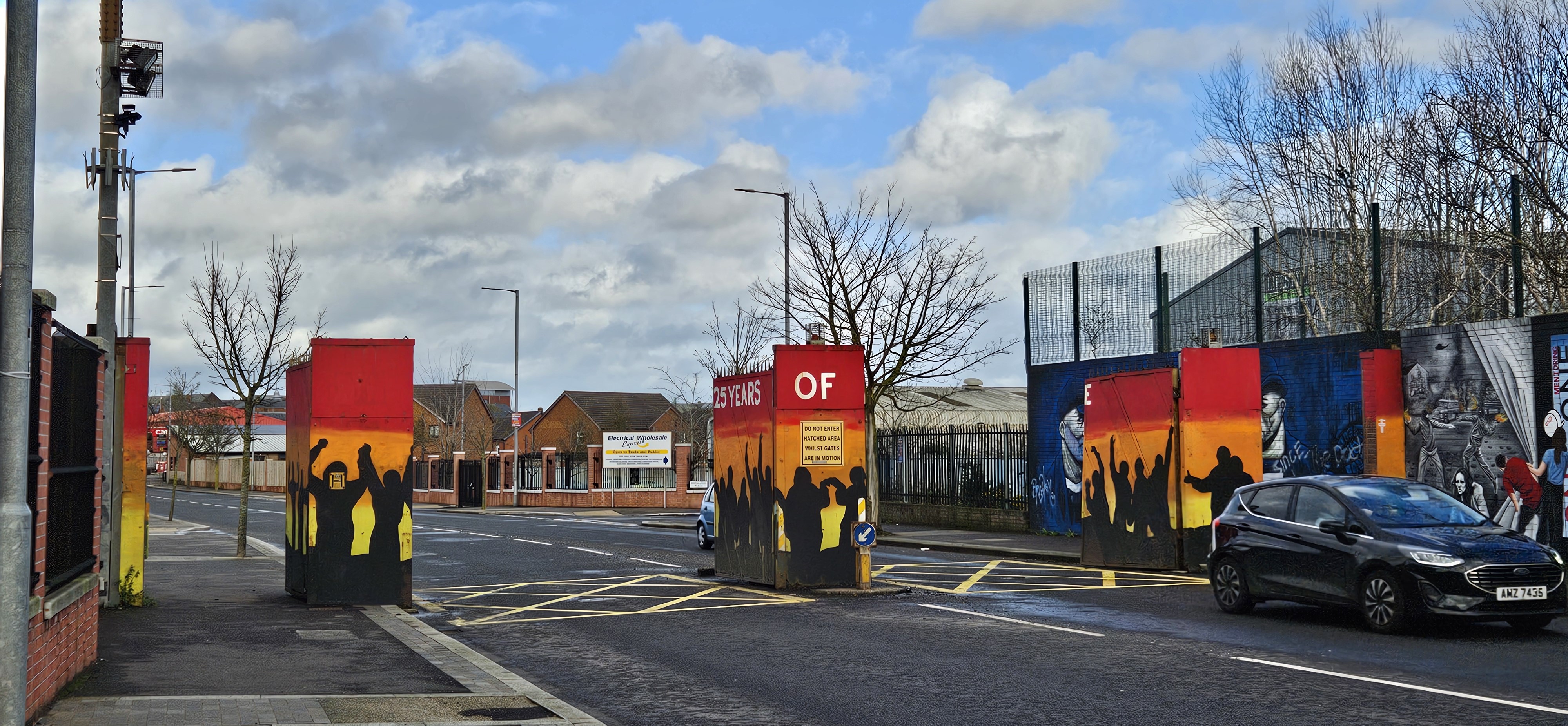
There is a section of the wall which has been dubbed the “Peace Wall’. People from around the world come and sign the wall. Personally, I don’t understand how a barrier which was built in the midst of violence, and still stands to serve its purpose, can be associated with peace. Furthermore, why would anyone want to apply their name to it?!?! Let’s rejoice when it is finally torn down.
However, most notably for me was the practice of some towns and villages to fly the flag representing their allegiance: either the Union Jack (for a protestant Unionist town) or the tricolour of green/white/orange (for a Catholic town supporting the Irish Republic). Thankfully, there are many towns where no flag is flying at all.
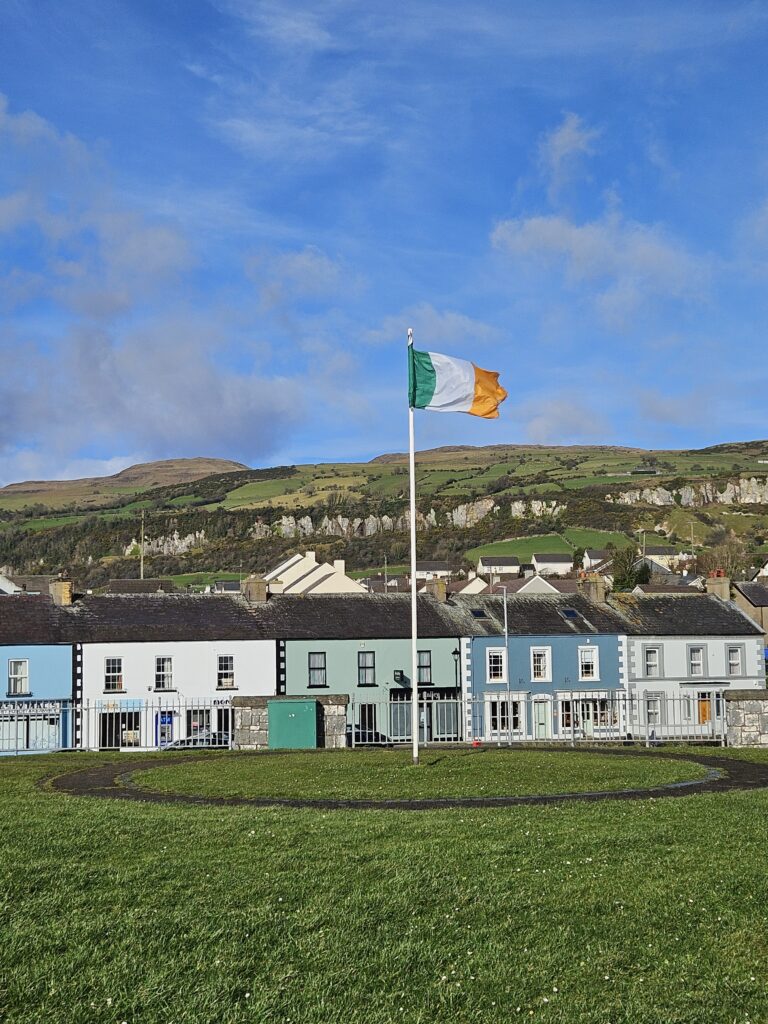
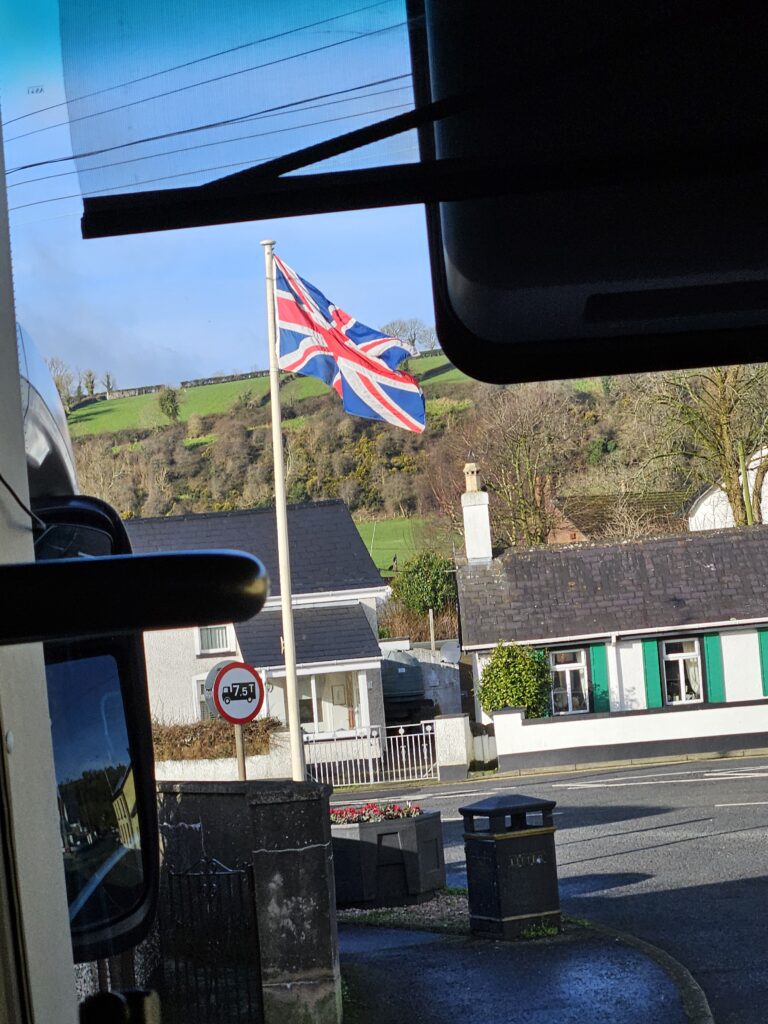
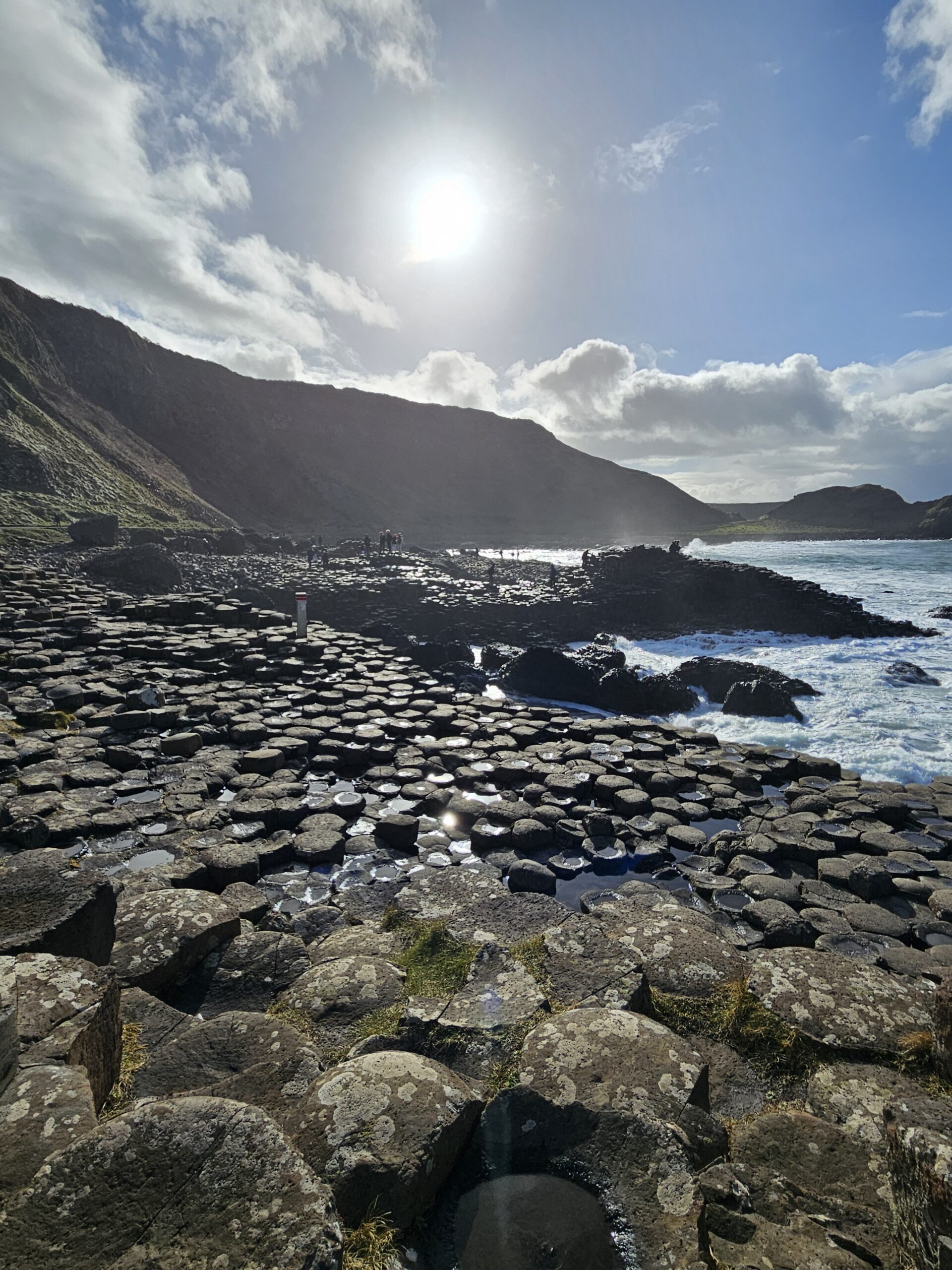
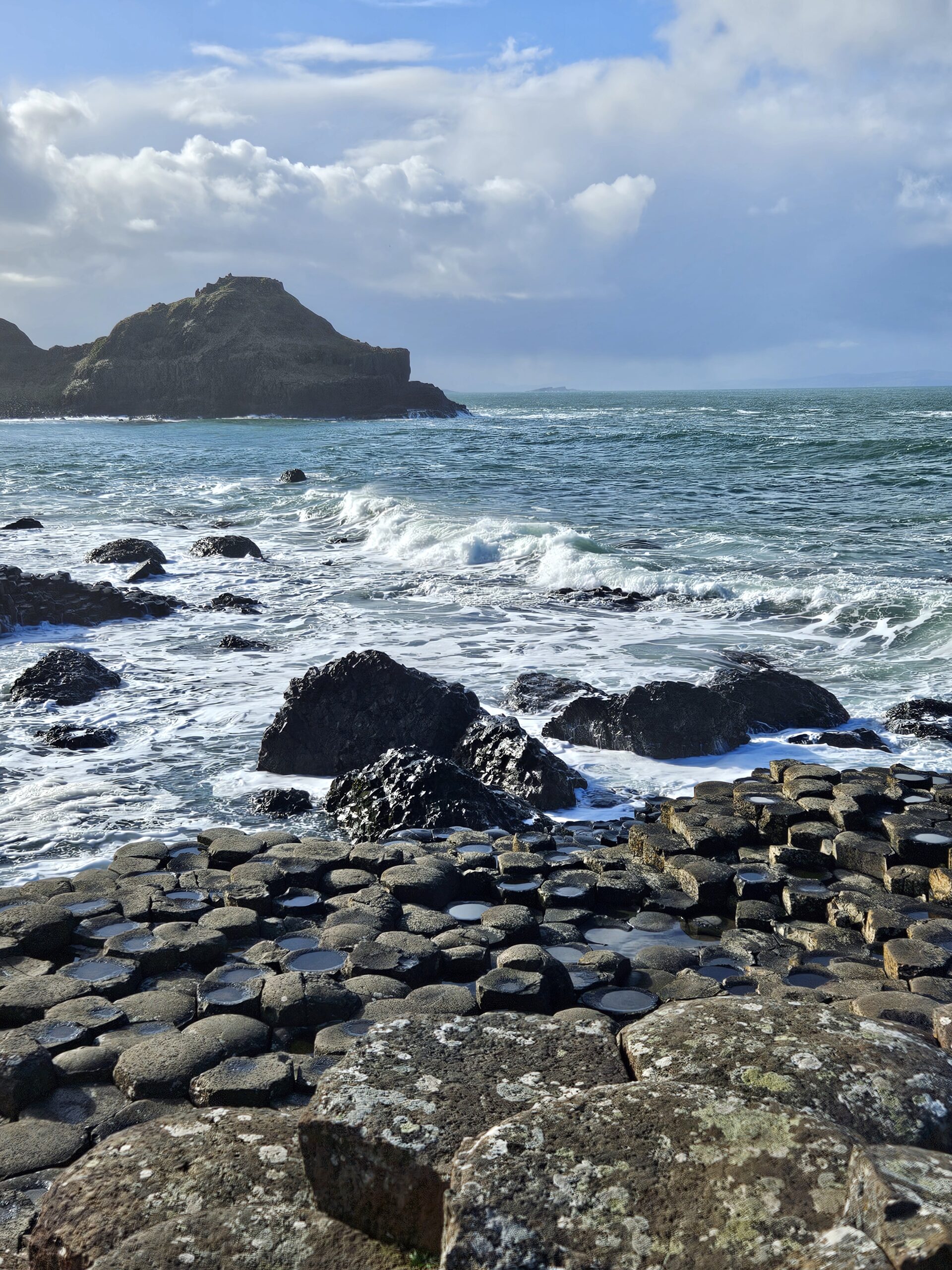
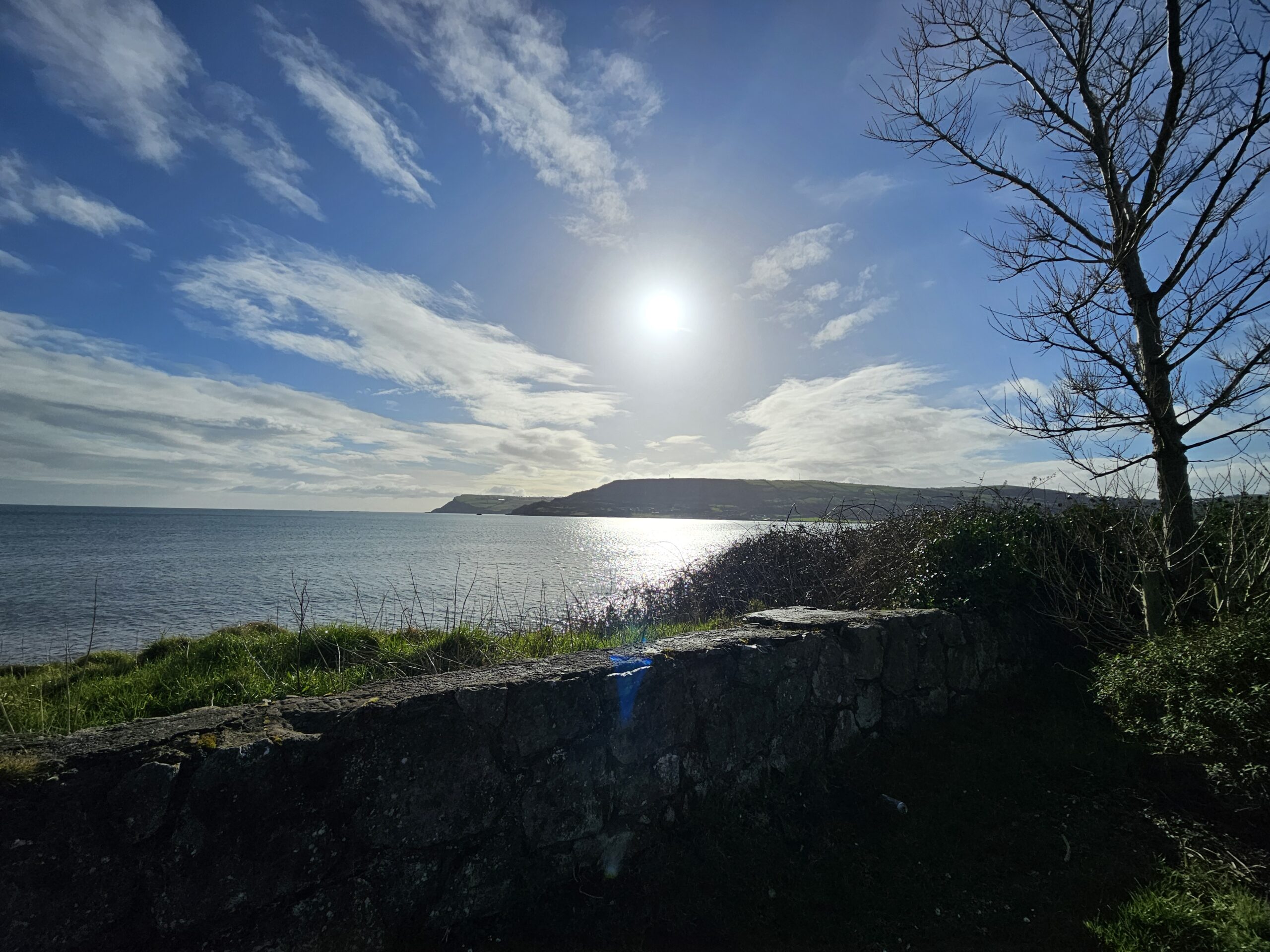
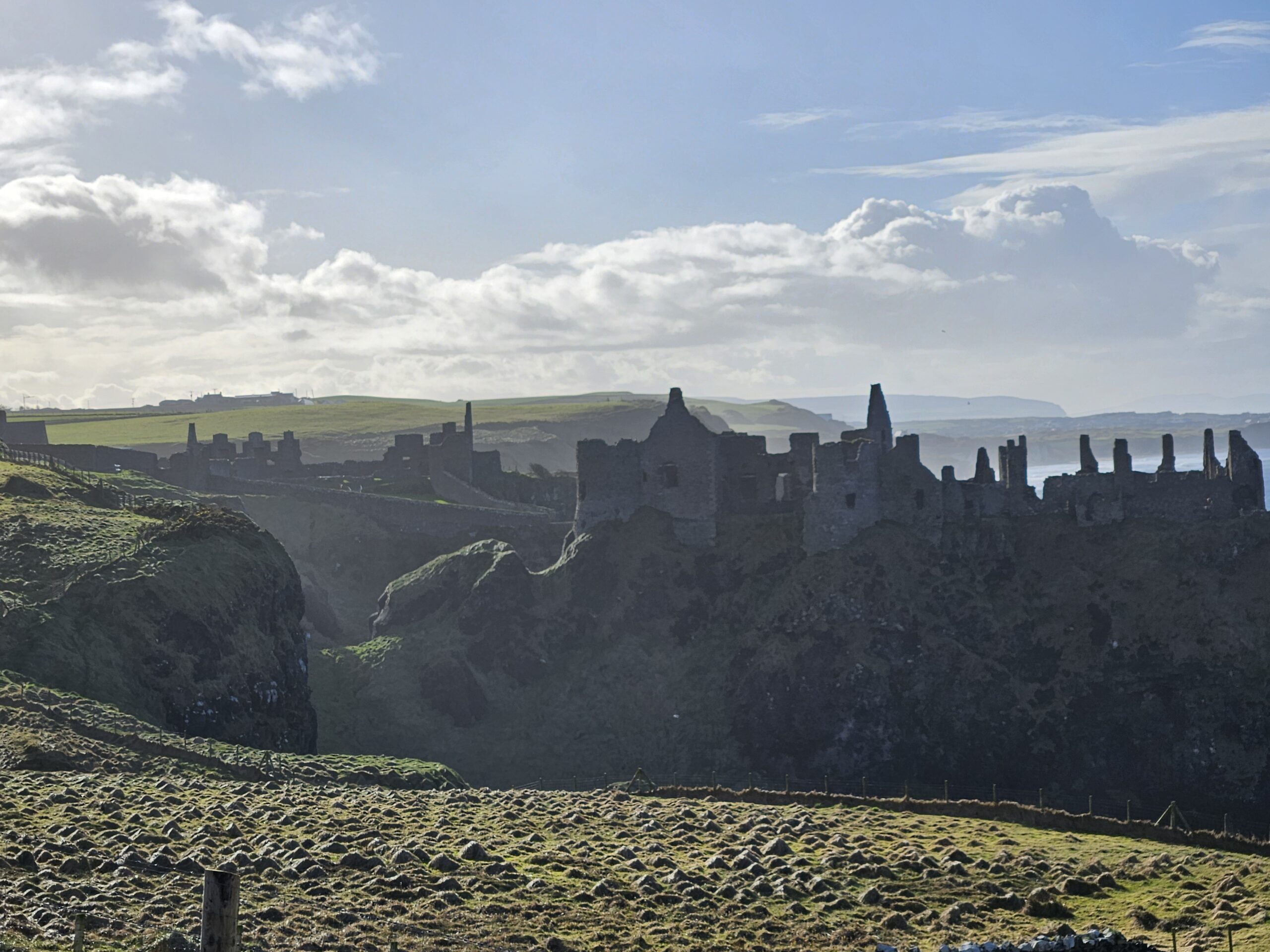
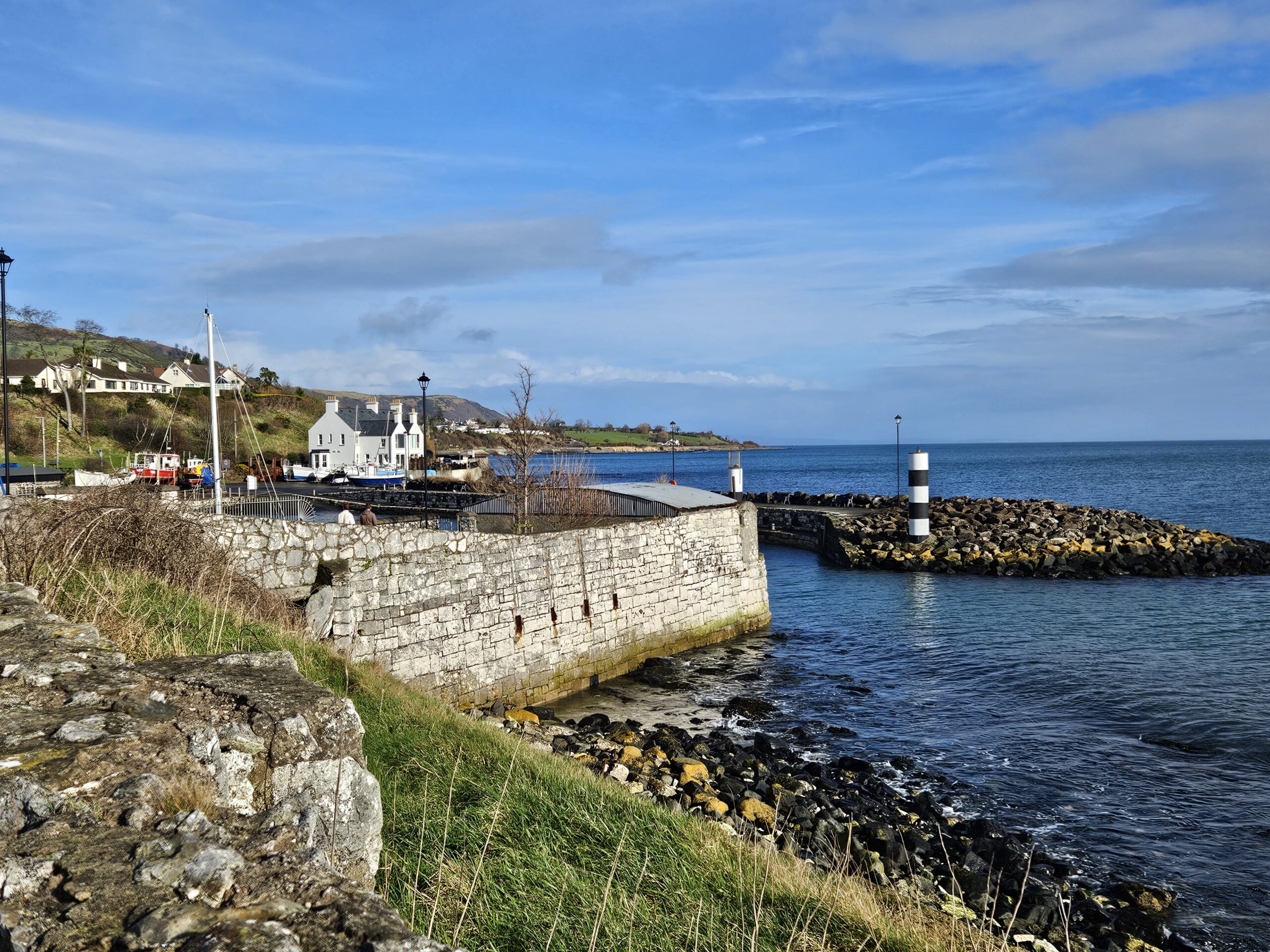
These photos of the flags were taken when I did a day tour from Belfast to see the Giant’s Causeway. This is a geological formation which was created 400 million years ago from a volcanic eruption. It then took 300 to 400 years to cool down, making its distinctive shapes. The coastline was spectacular, and the sea air was refreshing. And the drive was punctuated with wonderful sights.
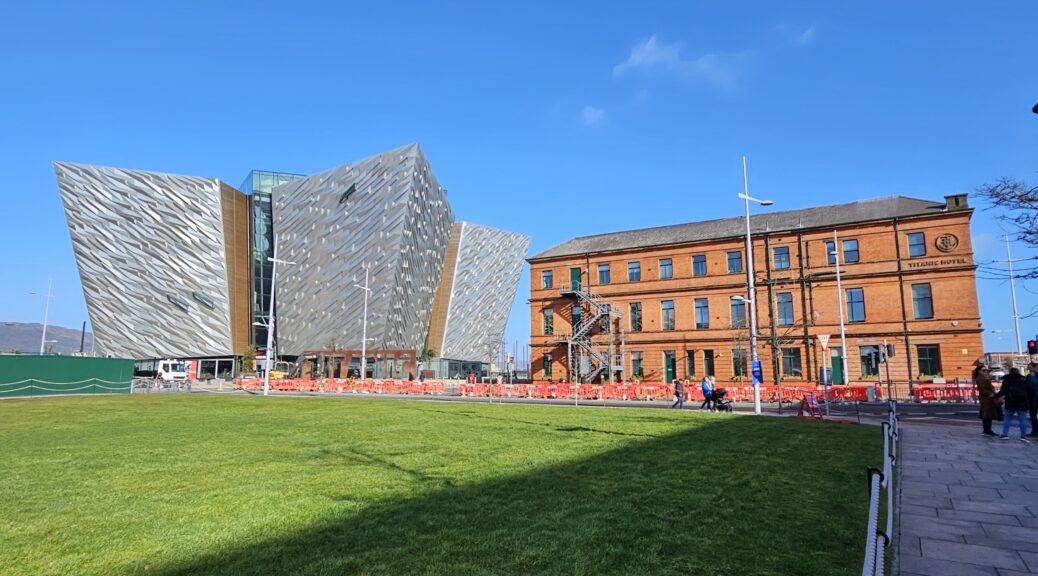
Ever since I had decided to visit Ireland, I had been looking forward to visiting the Titanic exhibition. Titanic Belfast is a tourist attraction which is predominantly housed in a multi storey complex built where the shipyard was located where the Titanic was built. The outside of the building is clad in anodised aluminium, and the building itself is shaped with angles like a ship’s prow. (See feature photo at the start of this post). It can be seen for miles, as it beckoned me while I walked towards it along the Queen’s Quay, which is a section of the River Lagan.
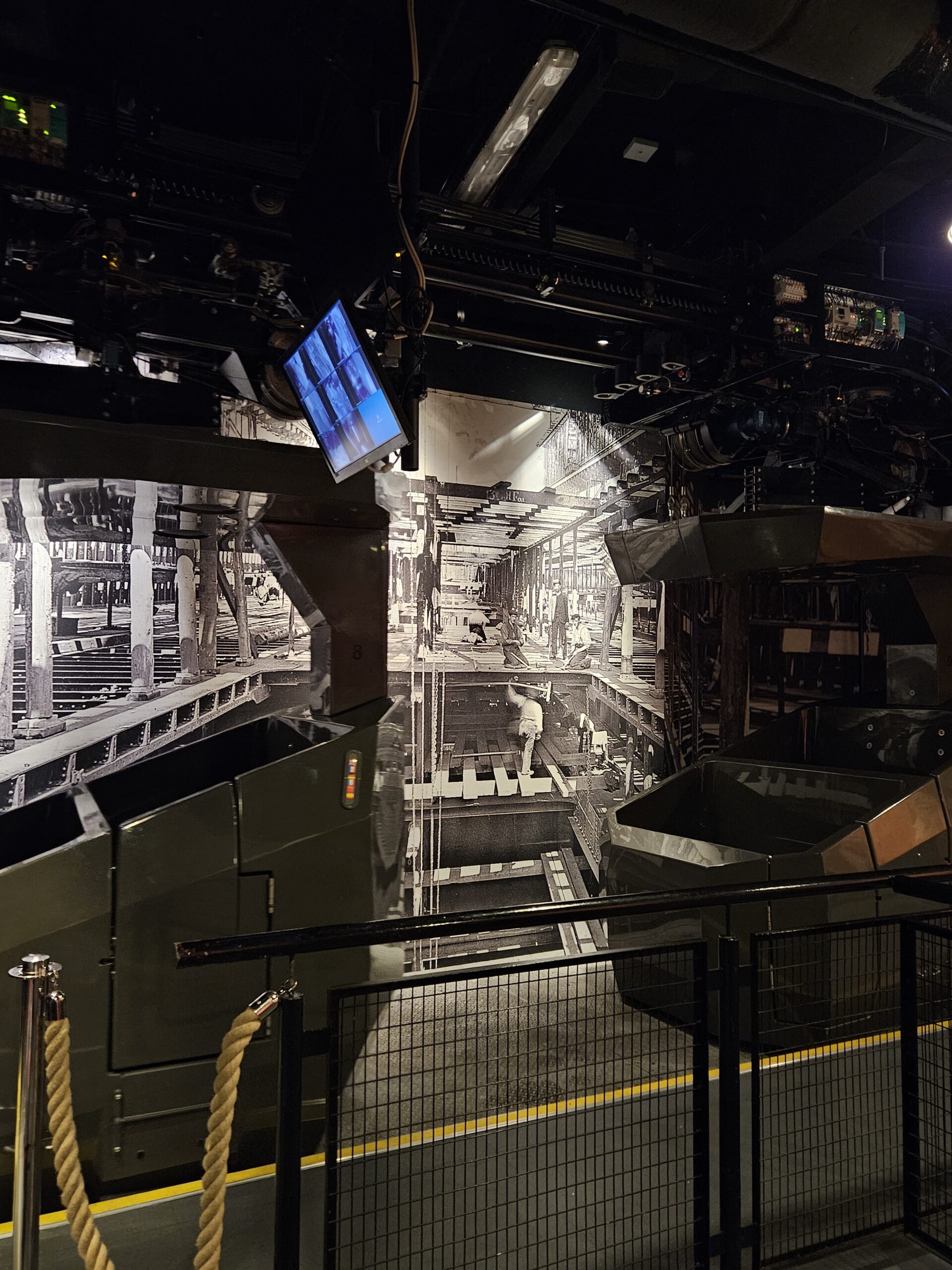
The exhibition was terrific. You start on the ground floor, with information about Belfast at the time the Titanic was built. Then, when you get to the exhibit about the shipyards, you take a lift up a few floors, as if you are ascending the gantry. There is a short ride taking you through a shipyard with a commentary on what it would have been like to work in the shipyard of the time. At the end of the ride, further displays take you through the history of the design and build of the ship, its fitout and launch, its sinking and finally the aftermath of tragedy, investigation and outcomes. It was all done exceedingly well.
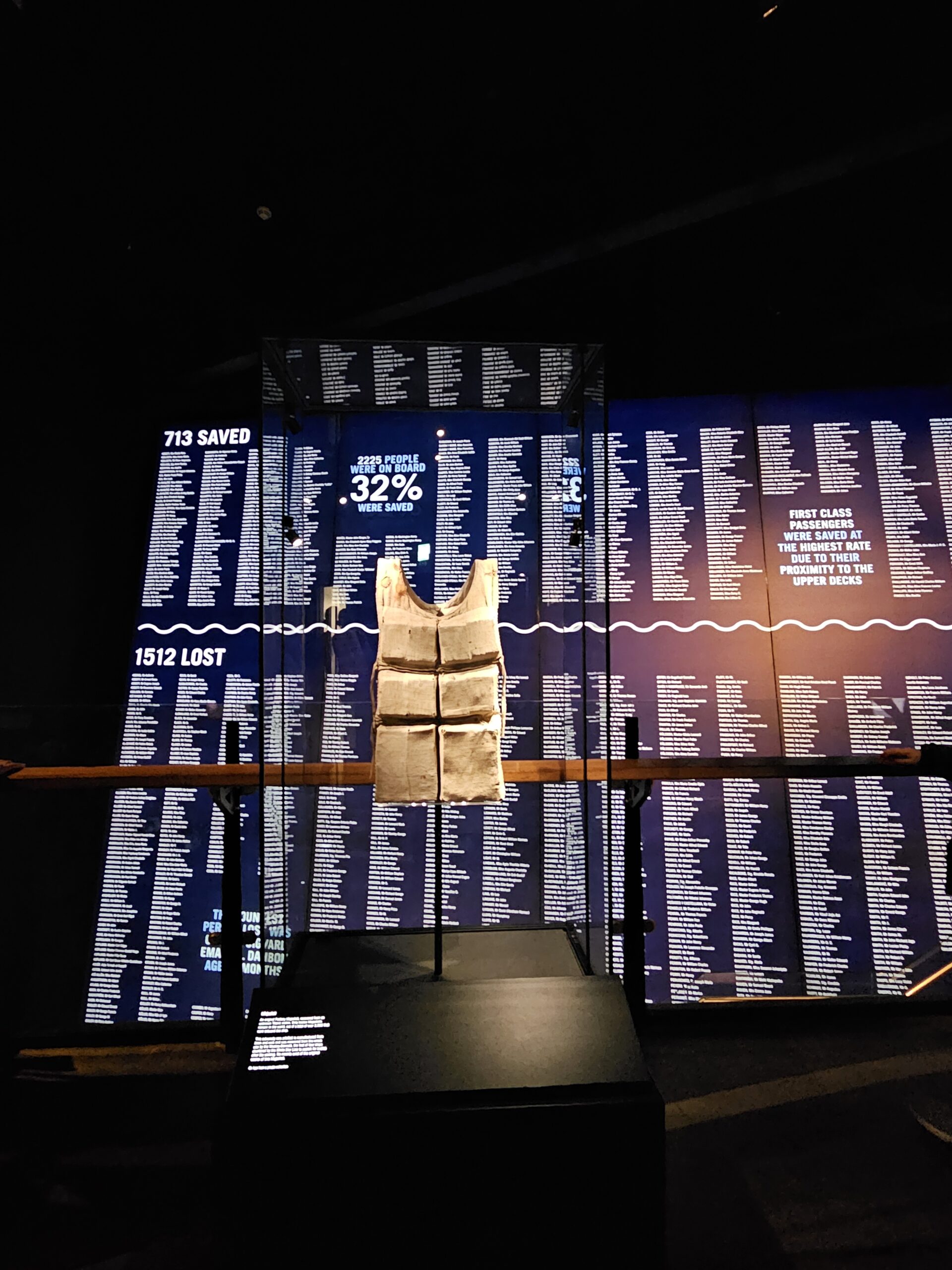
Before I came away, I read “A Night To Remember” by Walter Lord. The book was published in 1956 after Lord carried out extensive research, including speaking to survivors and their families. It is not fiction, but the facts are so dramatic and, at times utterly fantastic, that I had to remind myself that this was a real event. The picture Lord painted about life on board was fascinating. While the discrimination between the various classes of people was normal for the time, what played out during the sinking and the life-saving attempts was despicable. And the survival statistics will forever document this. For example, only 4 First Class women died (3 of them by choice) out of a total of 143. On the other hand, 15 of the 93 Second Class women died, and there was a huge 81 casualties of 179 Third Class women. (page 91)
It was a different world back then. The First Class passengers were an elite group who were known to each other; Lord describes the trip as “more like a reunion than an ocean passage”.
Lord writes, “It was easier in the old days….for the Titanic was also the last stand of wealth and society in the centre of public affection. In 1912 there were no movie, radio or television stars; sports figures were still beyond the pale; and café society was completely unknown. The public depended on socially prominent people for all the vicarious glamour that enriches drab lives”. (page 94)
Lord believed that the sinking of the Titanic represented something of a line in the sand, after which this way of living was never the same again. Moreover, and thankfully, some of the prejudices of the day were toned down (I’d love to say that they went away, but that wouldn’t be entirely true, unfortunately). Lord writes about how people talked about the “superiority of Anglo-Saxon courage”. He elaborates: “To the survivors all stowaways in the lifeboats were ‘Chinese’ or ‘Japanese’; all who jumped from the deck were ‘Armenians’, ‘Frenchmen’, or ‘Italians’.” (See page 97 and 98 of the book for further atrocious examples of racism)
In his book, Lord sums it all up; “What troubled people especially was not just the tragedy – or even its needlessness – but the element of fate in it all. If the Titanic had heeded any of the six ice messages on Sunday … if ice conditions had been normal … if the night had been rough or moonlit … if she had seen the berg fifteen seconds sooner – or fifteen seconds later … if she had hit the ice any other way … if her watertight bulkheads had been one deck higher … if she had carried enough boats … if the Californian had only come. Had any one of these “ifs” turned out right, every life might have been saved.” (page 149) This summation of the event is echoed in one of the museum’s exhibits.
I left the building in a very sombre mood.
Finally, what of Emily’s visit in 1885?
Did she visit Belfast?
Yes, she did, Emily describes Belfast as “the chief manufacturing city of Ireland, and next to Dublin in importance.” “The streets are for the most part wide and clean, and the city generally appears to be well laid out. Many of the public and private buildings are exceedingly fine”.
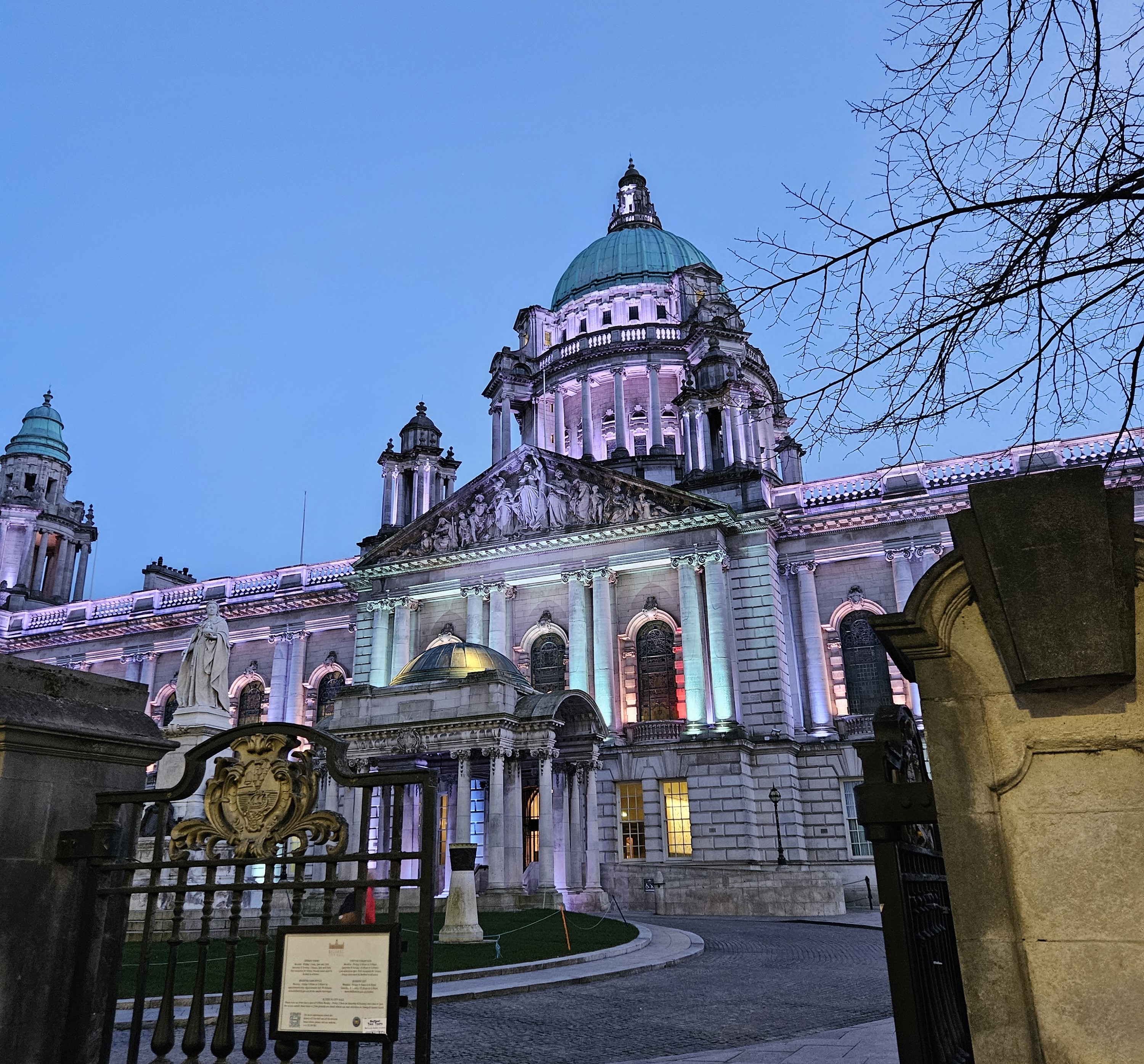
Emily mentions the City Hall,…..
…. And the Customs House; I even discovered in the Titanic Museum a photo of the Customs House, as it was in 1897.
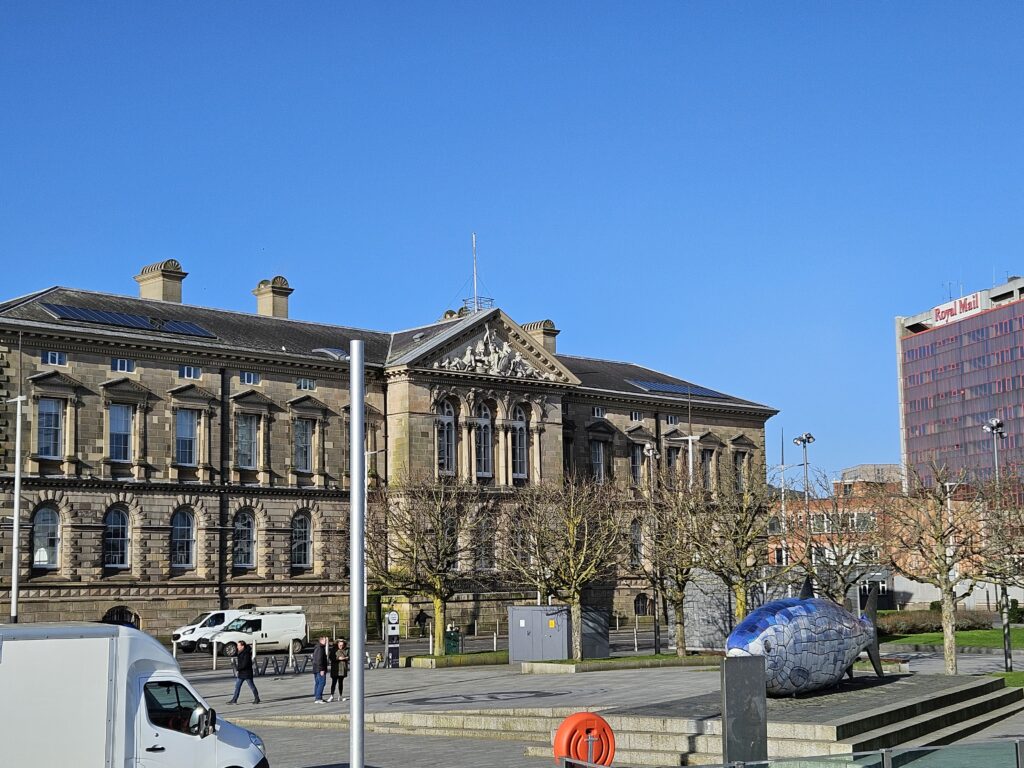
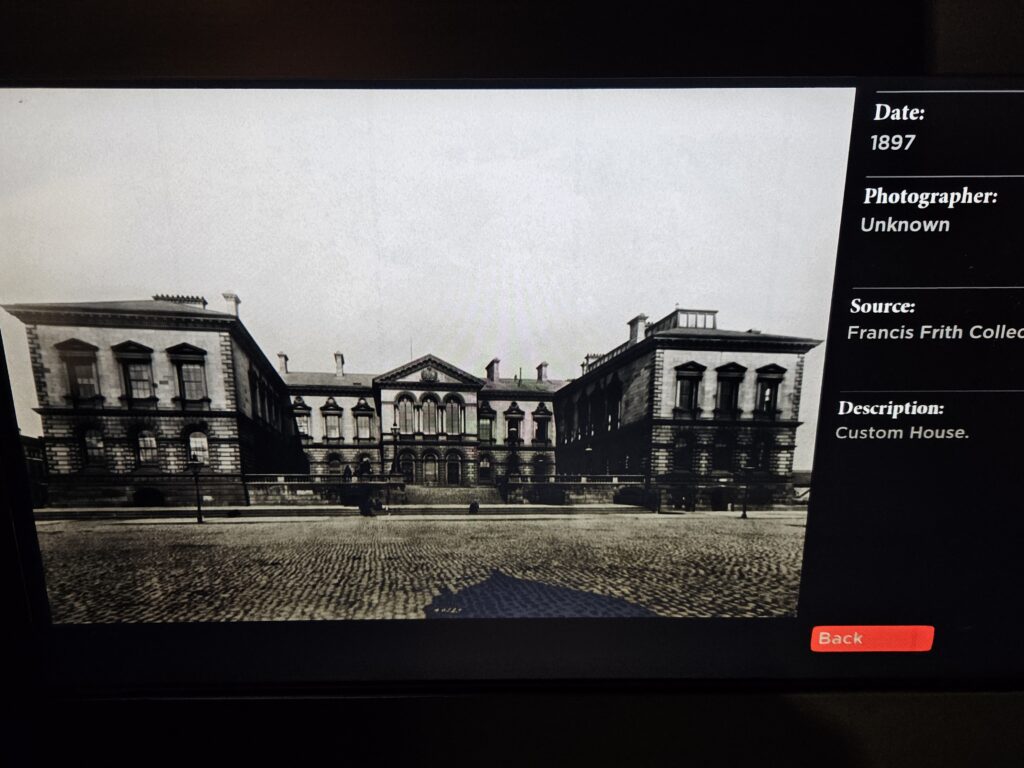
I felt a strong connection to Emily when, unbeknownst to me, it turned out that the hotel I was staying in, the Merchant Hotel, had once been the headquarters of the Ulster Bank which Emily mentions in her book. It was as I was sitting having breakfast one morning admiring the extraordinary ceiling of the restaurant, that I wondered if she had also seen it.
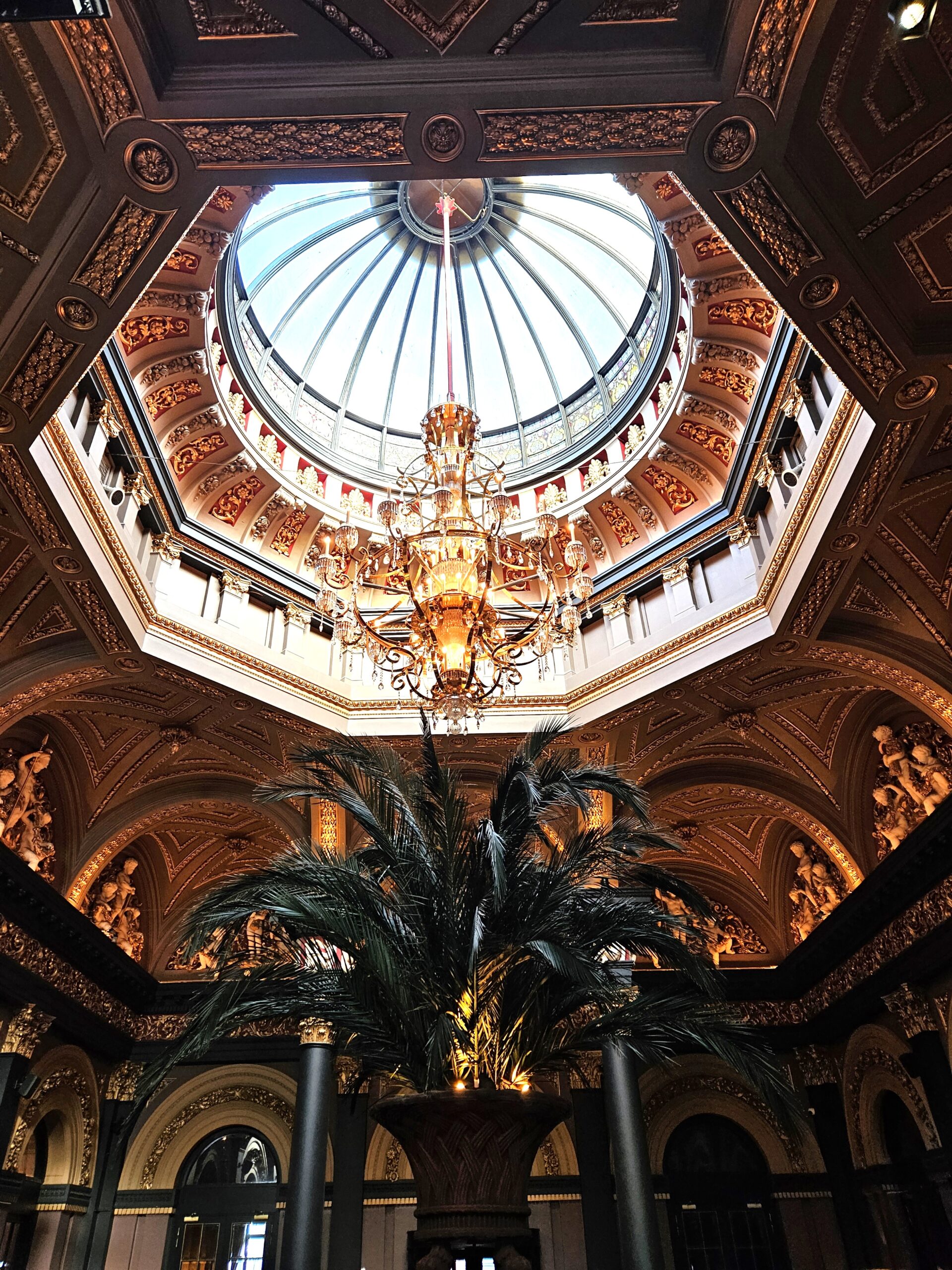
I don’t know whether she did, but it was enough to know that she had been close.
It was a fitting revelation to mark the end of an amazing stay in Belfast.