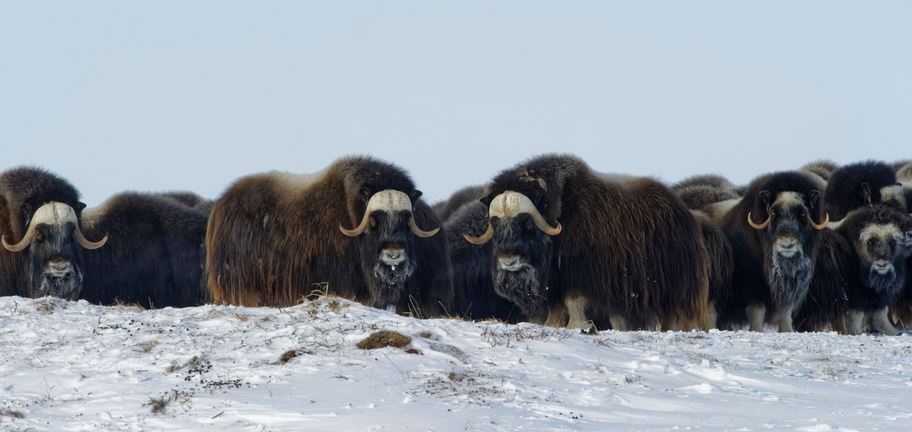
Musk oxen
Welcome to the second post of Big Beasts of Alaska!
Thank you, Claire, for your research!
Characteristics and living habits
I was wanting to start this post by describing musk oxen as large, stocky shaggy-haired animals. But then I read that bulls grow to an average of 5 ft tall, and cows to an average of only 4 ft tall. So, they are not the huge animals which the photos imply after all. (Even though they weigh anywhere from 220 to 600kg!). But I’m still going to stand by them being a “big beast”, if not because of their height, at least because of their weight??
Having said that, even though the average male musk ox will only reach up to my nose, I definitely wouldn’t be waiting around to have a conversation with it. Particularly when I have learnt that musk oxen wash themselves with their own urine to communicate during the rutting season, giving them a “musky” smell, from which their name is derived.
Musk oxen are most closely related to sheep and goats. Their coats are dark brown to dark grey-brown, and are made up of outer shaggy hair called “guard hairs”, as well as a shorter undercoat that provides the insulation needed for winter (but will fall out at the end of the season).
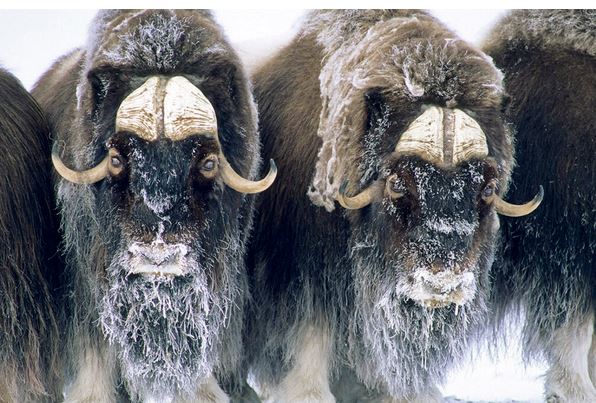
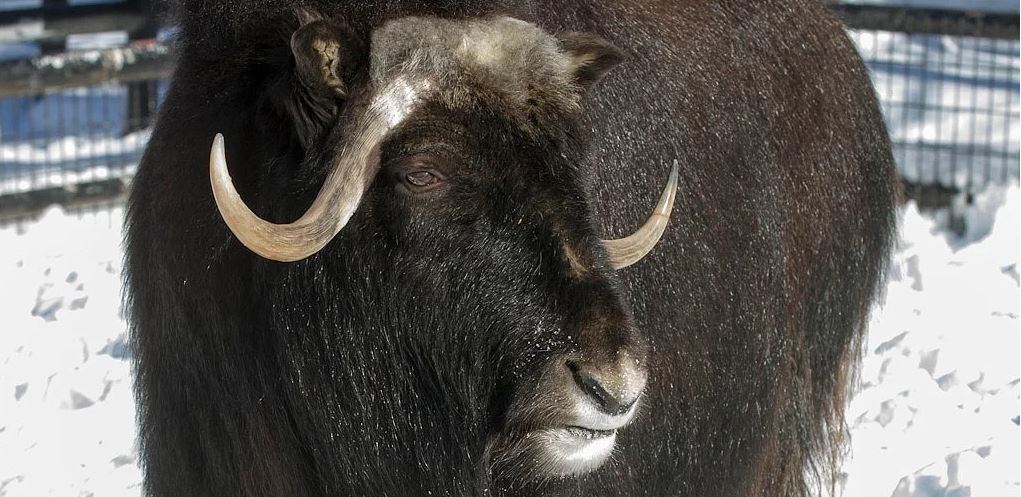
Musk oxen are herd animals which inhabit tundra, forest-tundra, and various barren lands. Their diet consists of tundra vegetation, primarily Arctic Willow and birch. In winter they will browse on lichens, twigs and grasses.
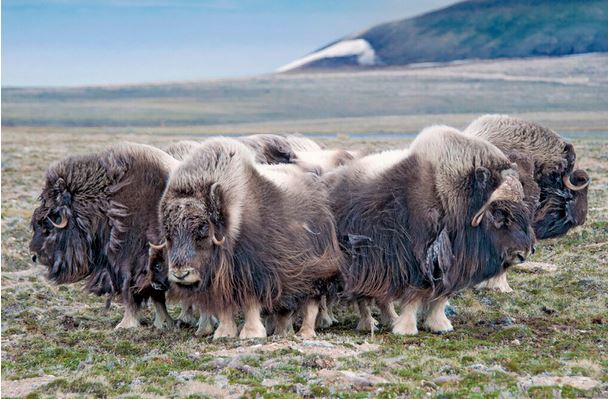
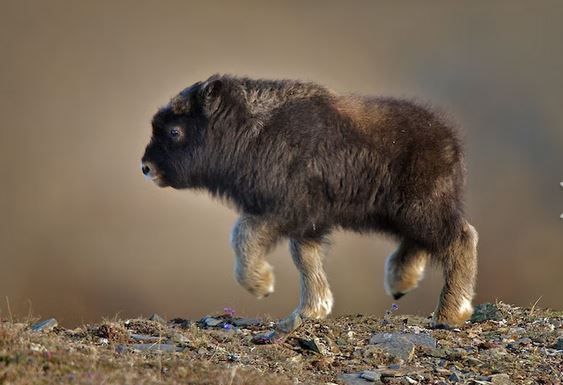
Herds can reach 50 animals, but 15-20 is more common. Musk oxen can be nervous and suspicious, and suffer from wolf and bear predation. The herds defend themselves, or more specifically their young, by forming a circle, with the young musk oxen in the centre and the adults surrounding them facing outwards towards their enemies. In the photo below you can just see the calf poking its head out on the left.
One calf (rarely two) is born after a gestation of about eight months. Calves suckle for 15-18 months, and may live 20-25 years.
Where did they originate?
Musk oxen were once indigenous to Alaska, having migrated from Siberia across the Bering Sea to North America and Greenland between 200,000 and 90,000 years ago. However, by the mid-1800s the Alaskan population had died out due to hunting, and possibly contributed to by changing climate. The species of musk ox found in Alaska is the Greenland musk ox. They are descendants of 34 animals transported to Alaska from Greenland in 1935. There are now several thousand in Alaska (estimated 5,300 with about 60% of those on the Seward Peninsula).
Oral histories?
Despite extensive searching by experts, few, if any, indigenous stories about musk oxen survive. Most put this down to the fact that they were scarce by the time the early European settlers arrived. Plus, when colonisation progressed, and the native population was decimated by newly introduced diseases, it is thought that indigenous histories of musk ox and their role in the communities’ lives either disappeared with death of the elders, or the oral histories were simply not recorded by the settlers and explorers.
The musk ox became a ‘ghost’.
Qiviut and its use today
The musk ox fine underfur (downy-soft underwool) is known by the Inuit word ‘qiviut’ (kiv-ee-ute). This underfur is highly prized, and is said to be eight times warmer than wool. It is not scratchy and will not shrink, making it ideal for clothing; for example Claire’s headband shown below.
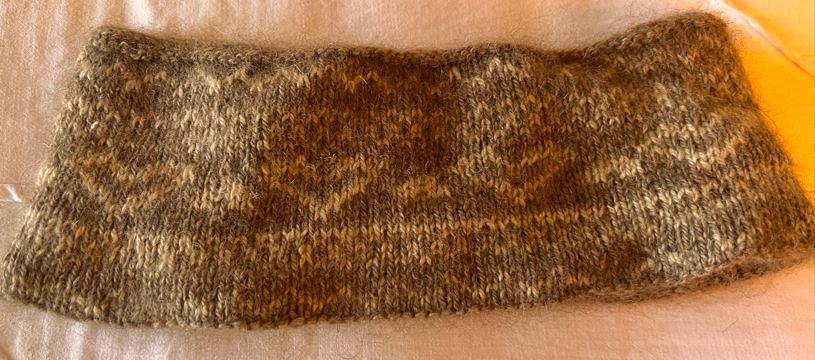
The Oomingmak Musk Ox Co-op in Anchorage has been making various handknits since 1969. The Co-op is owned by approximately 250 Native Alaskan women from various coastal villages. Each of these villages have their own specific designs. Women from the co-op hand-comb qiviut from musk ox living on farms, as well as from bushes and trees in the wild where the underfur has been shed.
Musk oxen in Nome
Nome, where we will be for the end of the Iditarod, has a significant number of musk oxen (36 were reintroduced in the Nome area in the 1970s). They now appear right in town, on streets, on school grounds, the cemetery, and in parking lots and yards, mainly during spring, summer and autumn – creating significant management challenges (considering that they are also a source of meat).
The photo below shows a herd of musk oxen right outside the Dredge No 7 Hotel, where we will be staying!
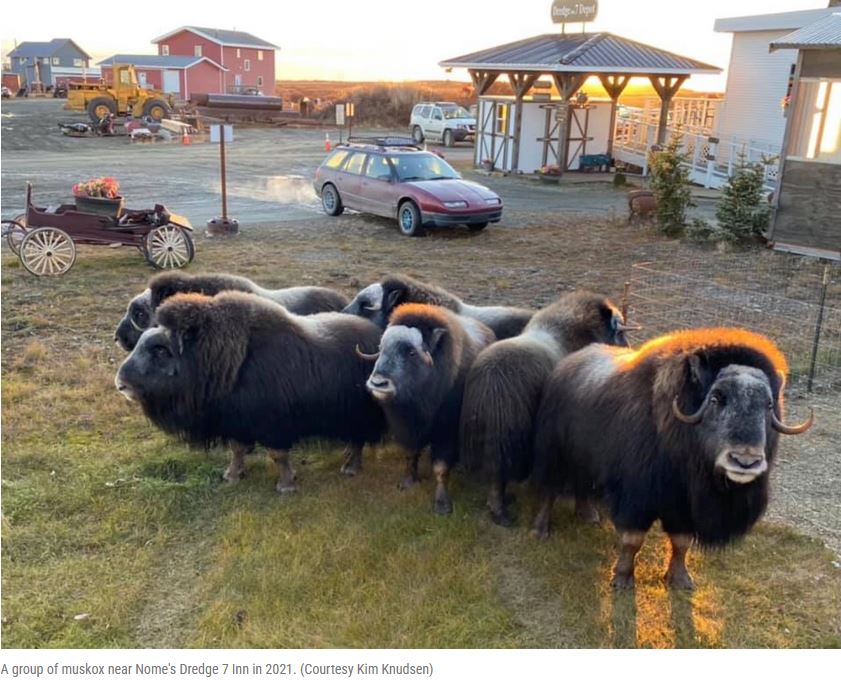
Musk oxen have injured people and animals over the years; in 2022 a trooper was killed in an attack while he was trying to protect his dogs. Nome Airport has even seen several musk oxen venture onto its runway; a fire truck has been used to spray the animals with water, which apparently they don’t like. The airport has also been experimenting with an inflatable bear effigy with bear urine spread around it. (I’d like to see that in action!?🤣)
Musk oxen management has become a contentious but localised issue in Nome, where hunting permits are now being issued.
The future for musk oxen?
What is happening to musk oxen populations elsewhere?
While musk oxen have survived previous climate change events of extreme cold and then warm, research is indicating that the current global warming event will potentially significantly impact musk oxen populations. The Arctic region is warming four times faster than anywhere else on Earth, and is driving Greenland herds further and further north. Deeper snow and ice tidal surges mean that the animals are finding it harder to access their winter grazing fields, leading to starvation. Musk oxen are also sensitive to pollution. Plus habitat loss from mining activities is further reducing food sources. And predation by bears has increased.
All this is taking its toll.
We can’t let the Alaskan musk ox become the ghost it once was in the nineteenth century.
As declared by One Earth:
“Let’s hope that we come to recognize the deep significance of these Ice Age survivors to the increasingly fragile web of Arctic life before it is too late, and before people have even become aware of a unique and magnificent large mammal that mas endured through millennia”.