
Moose!
Welcome to the first post in my Big Beasts of Alaska series. An expedition buddy, who is extremely knowledgeable about flora and fauna, and who is also on this Iditarod trip, kindly offered to contribute to my website, by researching and writing about some of the animals we are likely to encounter on our trip. (Thanks, Claire!)
Claire is starting with moose, which is the state land mammal of Alaska.
Moose derives from the Algonquin Indian word moz, meaning ‘Twig-eater’ (they are herbivorous, with a four chambered stomach). They are the largest living cervid (have hooves and antlers) and second largest land mammal in North America after the Bison. In Europe the Moose is known as the Eurasian Elk, which can be confusing as there is also a North American Elk, which is smaller than Moose.
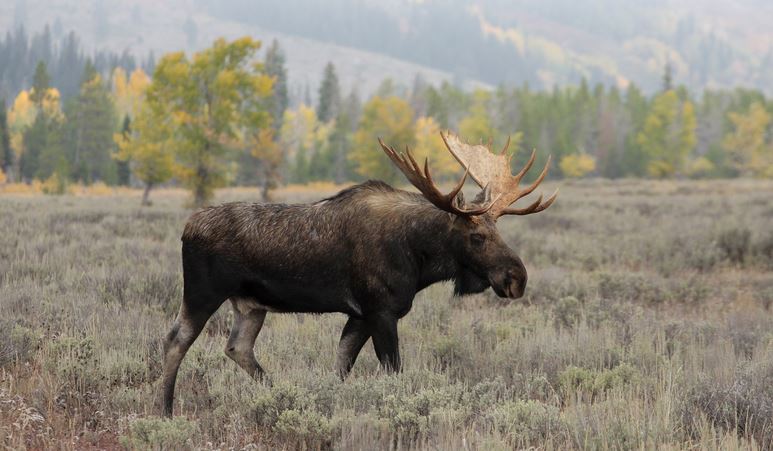
Moose are huge, standing 1.8 – 2.2 meters high, and weighing between 270-725 kilograms. Like muskoxen, and huskies, Moose have a double coat. The inner layer (or undercoat) comprises dense brown hairs, whereas the outer coat has coarse, hollow, insulating guard hairs. Moose shed their coat once a year in spring. They have spindly legs, short tails, prominent dewlaps (bell) on the throat, protruding muzzles, and long pendulous upper lips. Only the males grow antlers, and as a species are solitary, except during the autumn rut. They can run at speeds up to 56kmh, and a reasonable swimmers. Moose have poor vision, but exceptional hearing.
Moose can be dangerous, particularly females with calves. Using their hooves they can cause serious injury or death to sled dogs on the Iditarod trail. In 2024 (52nd Iditarod), musher Dallas Seavey, a five time champion, had to shot a moose with his handgun in self-defence as the moose charged his team and became entangled with the dogs. One of the dogs (Faloo) was injured in the attack, and had to be flown to Anchorage. Ultimately, Seavey received a two hour penalty for failing to properly gut the moose. Although Moose attacks are relatively rare, there have been a number of serious encounters. In 1985, musher Susan Butcher encountered a moose on the trail. She fended off the moose with an axe and a parka, but nevertheless two of her dogs died in the encounter, and 13 were injured.
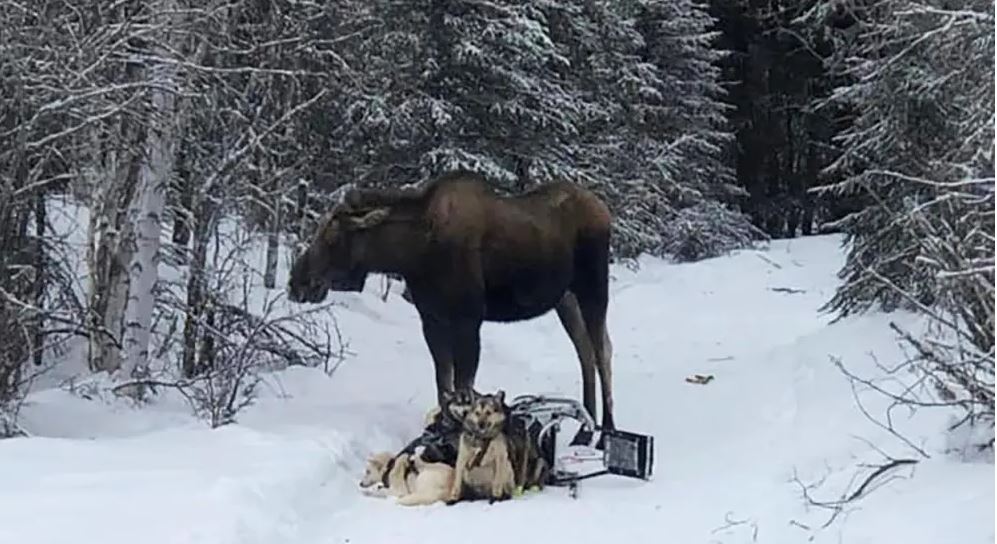
Bridgett Watkins, a rookie training to compete in the Iditarod, faced a moose who seriously injured four of her dogs. Watkins stated that “he’s trampling my dog team right down the centerline – lead dog down the line” . The attack didn’t stop until a friend arrived with a high-powered rifle to kill the moose. Fortunately all of the dogs recovered, but that doesn’t take away from the terrifying photo of the incident shown below.
Iditarod Rule 34: Killing of Game Animals, states “that if a big game animal is killed in defense of life or property, the musher must gut the animal and report the incident to a race official at the next checkpoint. Following teams must help gut the animal when possible. No teams may pass until the animal has been gutted and the musher killing the animal has proceeded”. This rule reflects “the high value Alaskans place on game meat, ethical hunting and respectful treatment of game animals” (Guardian, 8 March, 2014).
Why do moose attack? Jacob Pelham, a wildlife biologist with the Alaska Department of Fish and Game states “Moose tend to get grumpy late-to mid-winter. Its been cold out. A lot of their food is covered up (by snow). Another factor is moose looking for an easier, snow-packed path. It would also appear that moose can mistake sled dogs for wolves, which prey on moose”.
Finally, according to the Alaska Department of Fish and Game, “more people in Alaska are injured by moose than by bears each year”
In case we are charged by a moose while at the Iditarod, apparently we should:
- run away as fast as possible;
- get behind a large tree, rock, or other object;
- if you are knocked down, get up quickly;
- if injured, seek immediate medical attention
Good to know, Claire!
Sources:
-
Wilderness North, March 8 2022: Moose Iditarod 2022
-
The Guardian 9 March 2024: A moose attack, an injured dog, an improper gutting: drama at Alaska’s Iditarod, explained.
-
The Arctic Guide by Sharon Chester
-
A Complete Guide to Arctic Wildlife by Richard Sale
-
Alaska Public Media. 3 March 2022: Hungry, angry and aggressive moose put mushers on high alert before Iditarod.
-
CBS News. 9 February 2022.: Moose Attacks Iditarod Sled Team, injuring 4 dogs: “I ran for my life”
-
Alaska Department of Fish and Game. What to do about aggressive moose.
-
Alaska Wildlife rescue. Alaskan Moose
-
Visit Anchorage website. Moose