What is the Iditarod?
I want to be quite clear about something from the start ….
… I am not participating in a dog sled race!
I am, however, going to follow a dog sled race by attending the start, the finish and by visiting some checkpoints.
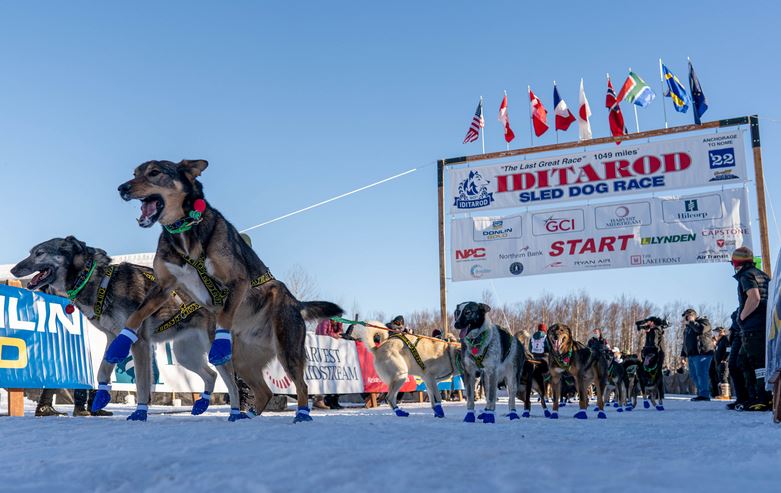
The race I will be following is the Iditarod Dog Sled Race. Each year a group of mushers race their dog sled teams from Anchorage to Nome across a trail which is over 1,000 miles long (over 1,600 kms), during late winter. The conditions are extremely challenging and unforgiving.
I have gathered some interesting snippets of information about the Iditarod Dog Sled Race:
| The name “Iditarod” comes from a word originating in the languages of the Athabascan native Alaskan people. The word means distant place. |
| Not only is there an Iditarod Race, but there is also the Iditarod Trail, plus the Iditarod River. And there was once a town called Iditarod, which developed after gold was discovered in the area. However, it is now abandoned. |
| The name “Iditarod” comes from a word originating in the languages of the Athabascan native Alaskan people. The word means distant place. |
| Not only is there an Iditarod Race, but there is also the Iditarod Trail, plus the Iditarod River. And there was once a town called Iditarod, which developed after gold was discovered in the area. However, it is now abandoned. |
| Some people think that the Iditarod Dog Sled Race is a recreation of the journey mushers took to urgently deliver diphtheria serum to Nome in 1925. This is incorrect, as the 1925 Great Race of Mercy or the Serum Run, as it is sometimes called, was only a small section of the Iditarod Trail. Read more about the history of the Iditarod Dog Sled Race in my next post. |
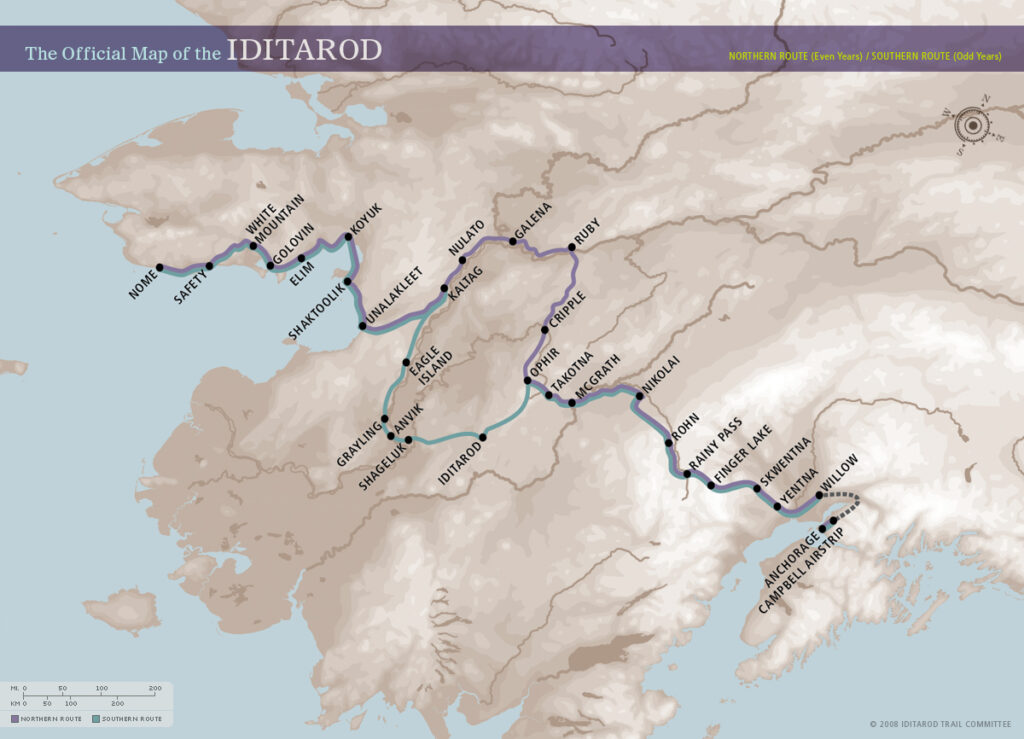
| The actual route of the Iditarod race changes, depending on whether it is an odd year or an even year. In 2026 the race is due to follow the northern route, which has 25 checkpoints (including the start and the finish) |
| The race takes between 8 and 15 days. |
| As at the date of writing (5/10/25) there are 29 mushers who have registered for the race. The entrants can be viewed here. The most number of participants was in 2008 when 96 mushers started. Only 78 completed. |
| On average each team consists of around 12 to 14 dogs. The minimum number permitted is 12 and the maximum is 16 |
| There are official rules which cover the following (among many others) ……… |
- Musher qualifications; mainly around demonstrating relevant experience. A musher must be aged 18 or over
- Mushers’ kennels must comply with ITC Kennel Standards. ITC = International Thunderbird Club (I need to investigate this?!)
- Mushers draw their starting positions at the pre-race banquet (which I will be attending! Yay!)
- The maximum number of entrants is 100
- “No one convicted of a charge of animal abuse or neglect, as such is defined under Alaska law, may enter the Iditarod Trail Sled Dog Race.”
- The fee to enter is USD $4,000
- “The race will be held as scheduled regardless of weather conditions. The course covers approximately 1,000 miles of mostly arctic wilderness. The trail will be broken and marked prior to the race, but due to weather conditions there will be no guarantee of broken trail during the race.”
- There is prize money which is distributed amongst all the mushers. Teams which finish 21st or after still receive a prize; in 2025 this was $2,000
- Mushers must make at least one 24-hour stop
- Up to 3 sleds can be used
- There is a list of mandatory items which must be taken along. Additional gear and supplies can be shipped to selected checkpoints for the musher to collect while on the race
- Rule #19 talks about Driverless Team situations (Argh!)
- There are rules about tethering, passing and parking teams
- And there are rules designed to promote general good behaviour and sportsmanship.There is no planned physical help permitted, with the exception that “common resources available to all mushers will not be considered outside assistance, however, in-person wake up calls for mushers will not be permitted.” (The last bit shows just how big a problem sleep deprivation is for the mushers!)
- There are many rules which cover dog care, both pre-race and during the race. They include testing and veterinary exams. Rules also cover what happens should a dog die in connection with the race.
- This rule was particularly eye-opening…..”In the event that an edible big game animal, i.e., moose, caribou, buffalo, is killed in defense of life or property, the musher must gut the animal and report the incident to a race official at the next checkpoint. Following teams must help gut the animal when possible. No teams may pass until the animal has been gutted and the musher killing the animal has proceeded. Any other animal killed in defense of life or property must be reported to a race official, but need not be gutted.”
So, this represents the start of the research and writing for my next adventure.
In my blog I will be exploring the history of the Iditarod Dog Sled Race. And I can’t imagine that I will be able to keep myself from diving into Alaskan history. I thought that I would be struggling to find topics. However, the moment I started my reading I realised that there is lots to learn…. and therefore lots to write about!
I’m very excited!
Sources:
-
Iditarod The Last Great Race – official website.
-
Travel Alaska website
-
Iditarod Official Rules 2026